 Digital Team
India and the European Union finalise a sweeping Free Trade Agreement, unlocking vast market access, redrawing supply chains, and reshaping U.S. trade dynamics amid global economic fragmentation.
India and the European Union on January 27, 2026, announced the conclusion of the long-negotiated India–EU Free Trade Agreement (FTA), a pact widely described by policymakers as the “mother of all trade deals.” Covering goods, services, investment and regulatory cooperation, the agreement signals a decisive shift in global trade alignment, with significant implications for exporters, investors and the United States amid ongoing trade tensions.
Why the India–EU FTA Matters Now
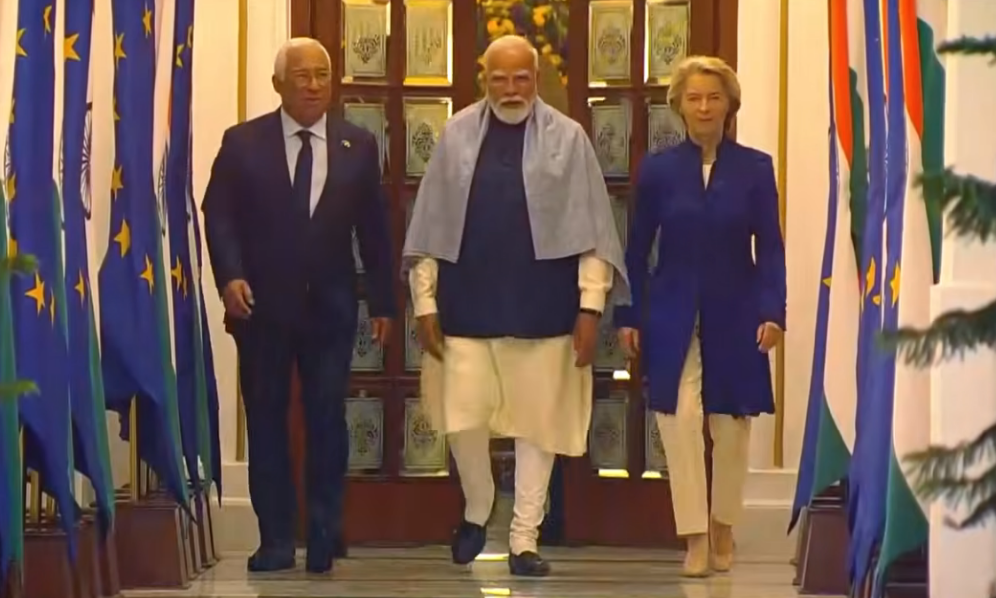
The India–EU FTA arrives at a moment of accelerating geopolitical and economic realignment.
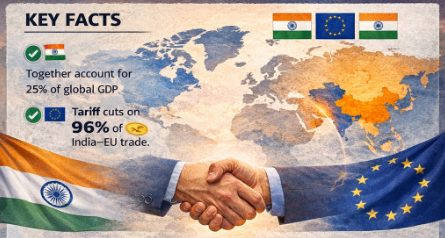
Together, India and the EU account for nearly 25% of global GDP, making this one of the largest bilateral trade agreements ever concluded. Its timing—amid supply-chain diversification away from China and renewed protectionism in parts of the West—adds to its strategic weight.
For India, the deal offers expanded access to a high-value market. For Europe, it secures a foothold in one of the world’s fastest-growing major economies.
What the Agreement Covers: Key Provisions Explained
According to official summaries released by both sides:
- The EU will eliminate tariffs on over 90% of tariff lines, covering 91% of trade value
- India will remove tariffs on roughly 86% of tariff lines, covering 93% of trade value
- Overall trade liberalisation reaches over 96% for India and nearly 99% for the EU
The agreement spans:
- Goods trade and tariff reduction
- Services and investment liberalisation
- Intellectual property protection
- Regulatory cooperation and dispute settlement
- Rules of origin and customs facilitation
EU officials estimate annual duty savings of up to €4 billion for European exporters.
Automobiles, Manufacturing and Supply Chains in Focus
One of the most closely watched sectors is automobiles, long protected by steep Indian import duties.
Under the India–EU FTA:
- Car tariffs will be phased down over several years
- Initial duties fall to 30–35%
- Long-term rates move towards around 10% in many categories
- Auto components see earlier and deeper cuts
This recalibrates supply-chain economics, making India more attractive for European manufacturing investment.
Five Big Wins
✅ 1. Massive Tariff Cuts Across Most Goods
- The European Union eliminates duties on 90%+ tariff lines
- India removes tariffs on ~86% of tariff lines
- This sharply lowers landed costs and immediately improves price competitiveness for exporters on both sides
Why it matters: Tariffs are the biggest trade barrier—cutting them delivers instant gains.
✅ 2. Strong Export Boost for Labour-Intensive Indian Sectors
- Key beneficiaries:
- Textiles & garments
- Pharmaceuticals
- Leather & footwear
- Gems & jewellery
- Engineering goods
Why it matters: These sectors employ millions, making this a jobs-linked trade gain, not just a corporate one.
✅ 3. Improved Access for Indian Services & Professionals
- Better market access for:
- IT & business services
- Financial and maritime services
- Temporary movement of skilled professionals
Why it matters: Services now form over 50% of India’s exports by value—this is structural, long-term growth.
✅ 4. Auto & Manufacturing Supply-Chain Integration
- Car import duties (earlier up to 100%) phased down over time
- Faster tariff cuts on auto components, machinery, electronics
Why it matters:
India becomes a manufacturing + assembly hub for Europe, not just a consumer market.
✅ 5. Surge Potential in FDI, Technology & Green Investment
- Stronger investment protection and regulatory clarity
- Expected inflows into:
- EV components
- Renewables & green tech
- Advanced manufacturing
Why it matters: This links trade with capital, technology, and skill transfer, not just imports/exports.
Advantages for India: Exports, Services and Investment
1. Export Growth
Indian sectors expected to benefit include:
- Textiles and garments
- Pharmaceuticals
- Chemicals
- Engineering goods
- Leather, gems and jewellery
The deal partially offsets competitiveness losses after the EU reduced GSP benefits in 2023.
2. Services Market Access
India secures improved access for:
- IT and business services
- Professional mobility
- Financial and maritime services
These provisions support high-value employment growth.
3. Foreign Investment and Technology
Clearer investment rules and stronger IP protection are expected to attract European capital into:
- Renewable energy
- Electric vehicle components
- Advanced manufacturing
Benefits for the European Union
European exporters gain:
- Preferential access to a large, youthful consumer market
- Stronger positioning in autos, machinery, spirits, luxury goods and chemicals
- Improved regulatory predictability for services and investment
Strategically, the deal aligns with Europe’s push for “friend-shoring” and reduced dependence on single-market supply chains.
Risks and Disadvantages: What Could Go Wrong
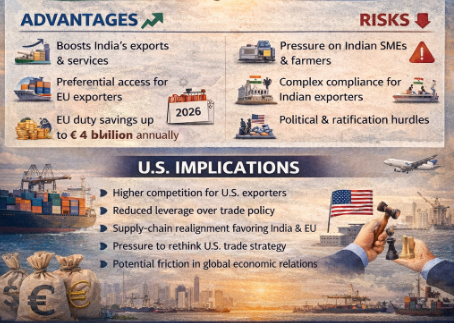
Despite its scale, the India–EU FTA carries notable risks.
Domestic Industry Pressure in India
SMEs and sensitive sectors such as agriculture and dairy may face heightened competition from European producers unless supported by transition policies.
Political and Ratification Risks
Trade agreements often encounter resistance. Parliamentary scrutiny in EU member states and domestic political concerns in India could slow implementation.
Compliance and Rules of Origin
Complex certification requirements may limit SME participation unless compliance support mechanisms are created.
Policy Space Concerns
Civil society groups have flagged potential constraints on public-interest regulation, particularly around intellectual property and health policy.
What the India–EU FTA Means for the United States
1. Intensified Export Competition
U.S. firms may lose price competitiveness in both India and the EU as preferential tariffs tilt trade flows toward India–EU partners.
2. Reduced U.S. Trade Leverage
The deal underscores limits to unilateral trade pressure and signals deeper economic alignment independent of Washington.
3. Pressure on U.S. Trade Strategy
The agreement may push the U.S. to:
- Re-engage in bilateral trade talks
- Offer competitiveness incentives
- Reassess protectionist policies
4. Supply-Chain Realignment
Multinationals, including U.S. firms, are likely to reconsider manufacturing and sourcing decisions to maintain market access.
Stakeholder Impact: A Quick Checklist
- Indian exporters: Upgrade quality, prepare for rules of origin
- European firms: Reprice products, expand Indian investment
- U.S. exporters: Monitor market share erosion
- Policymakers: Support adjustment and worker upskilling
- Investors: Track autos, green tech, pharma and services
A Structural Shift in Global Trade
The India–EU Free Trade Agreement marks a decisive turn in global commerce. It promises expanded markets and deeper integration but also demands careful management of disruption and political fallout. For the United States, it is both a strategic challenge and an invitation to rethink trade engagement in a multipolar world.
Handled well, the India–EU FTA could strengthen global economic resilience. Mishandled, it risks accelerating protectionist retaliation. Either way, it will shape trade policy debates well into the next decade.
FAQs
Q: What is the India–EU FTA?
A comprehensive trade agreement covering goods, services, investment and regulatory cooperation.
Q: When will the India–EU FTA take effect?
Implementation is expected during 2026, subject to ratification processes.
Q: Which sectors benefit most from the India–EU FTA?
Autos, pharmaceuticals, textiles, IT services, machinery and green technology.
Q: How does the India–EU FTA affect the U.S.?
It increases competition for U.S. exporters and reduces Washington’s trade leverage.
Q: Are there risks for Indian domestic industries?
Yes, especially SMEs and sensitive agricultural sectors without adequate transition support.
References
https://www.pib.gov.in/PressReleasePage.aspx?PRID=2219065&utm