 Digital Team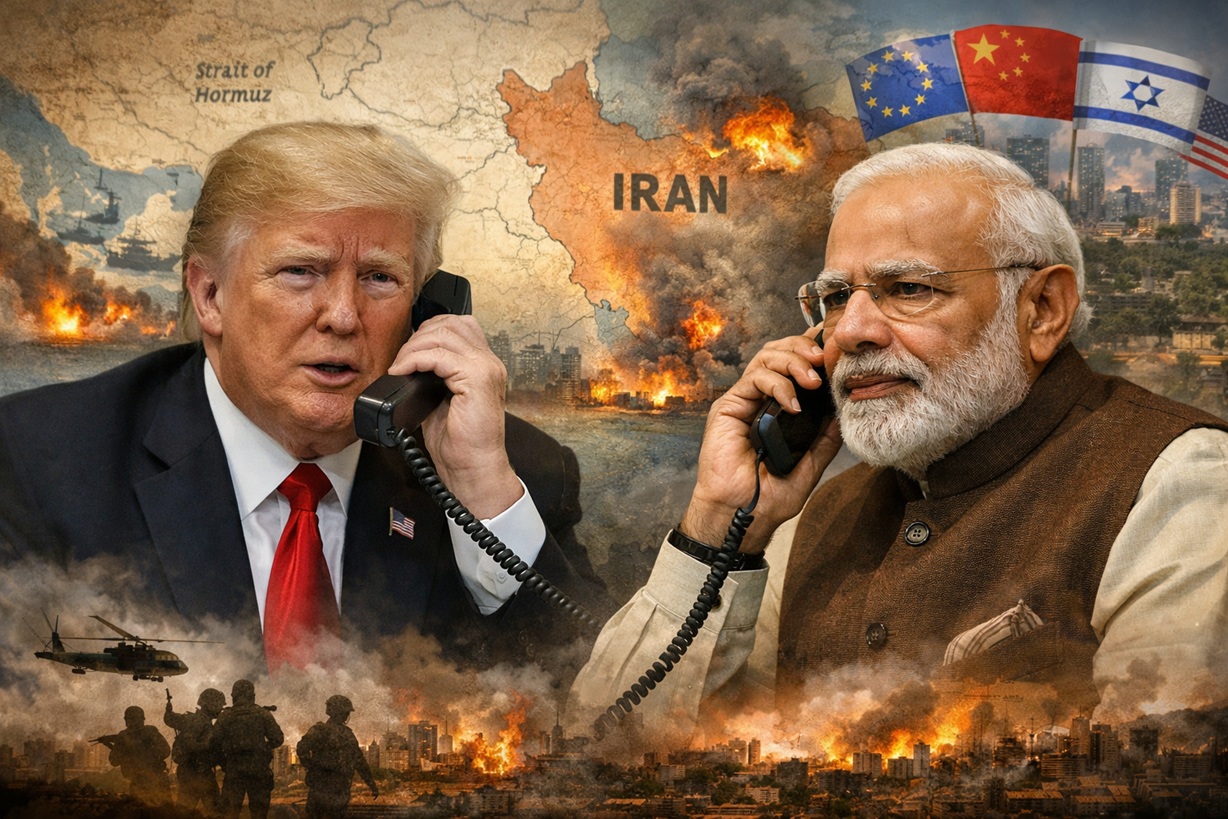
40-minute Trump-Modi call during Iran war highlights India’s rising diplomatic role and evolving global alliances
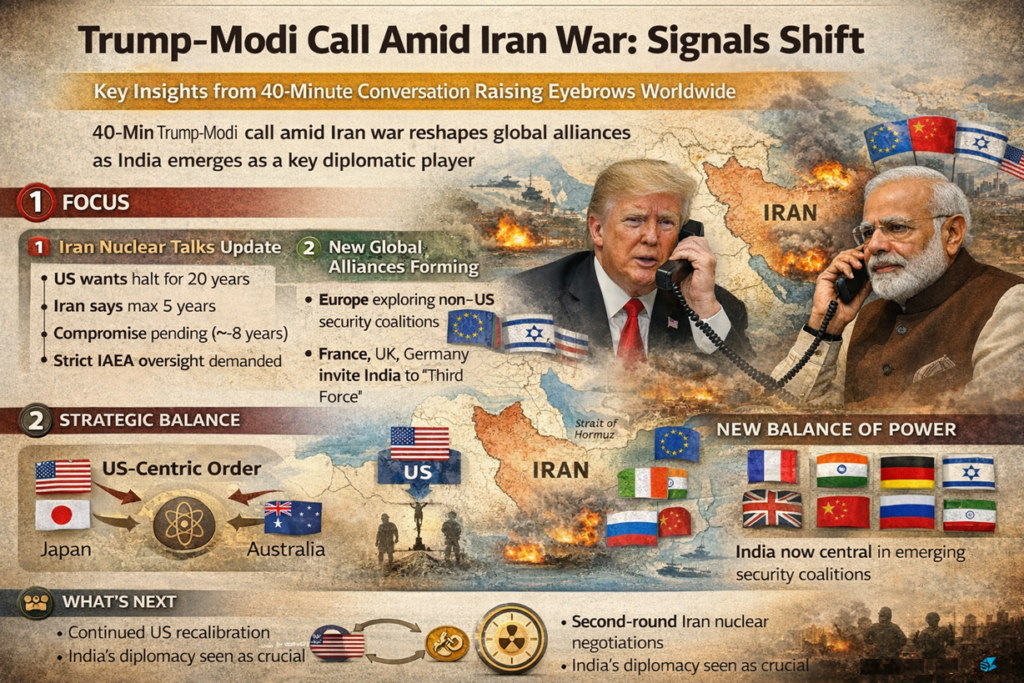
A 40-minute phone call between Donald Trump and Narendra Modi amid the ongoing Iran war has drawn global attention, signalling shifting geopolitical equations as West Asia enters its seventh week of conflict. The conversation comes at a time of economic turbulence and rising tensions around the Strait of Hormuz.
Trump-Modi Call During Iran War: Key Developments
The unusually long call between Trump and Modi underscores growing urgency in Washington as the Iran conflict deepens. While official readouts remain limited, diplomatic observers note the timing—immediately after a fragile ceasefire—as highly significant.
Trump’s outreach also coincides with his communication with Xi Jinping, where he reportedly urged Beijing not to supply weapons to Iran. This indicates mounting concern in the US over expanding geopolitical alignments.
Notably, Modi described Trump as a “friend” in his post-call communication—marking a subtle but meaningful shift in diplomatic tone.
Why the Trump-Modi Call Matters
India’s Strategic Position Gains Global Attention
India’s ability to maintain balanced relations across rival blocs—ranging from Israel and Iran to the US and Russia—has positioned it as a key diplomatic player.
Experts highlight that Modi’s foreign policy reflects “strategic autonomy,” allowing India to engage multiple stakeholders without overt alignment.
- Strong defence ties with Israel
- Continued trade relations with Iran
- Engagement with US, Europe, and Russia simultaneously
This multi-vector diplomacy appears increasingly relevant as global alliances fragment.
US Seeks Stability Amid Growing Isolation
The call comes amid signs of US isolation:
- European nations exploring independent security frameworks
- Strains with traditional allies like Japan and Australia
- Rising China-Russia coordination
Analysts suggest Washington may be recalibrating its outreach to partners like India to stabilise its global position.
Iran Nuclear Issue Remains Central
Stalemate Over Uranium Enrichment
The Iran nuclear issue continues to dominate negotiations:
| Issue | US Position | Iran Position |
| Nuclear halt duration | 20 years | Reduced to ~5 years |
| Monitoring | Strict IAEA oversight | Concerns over sovereignty |
The International Atomic Energy Agency has demanded full access to Iranian facilities, adding another layer of complexity.
Military and Strategic Developments
Satellite data indicates Iran has restored damaged airfields, enabling renewed military operations. This raises concerns that the ceasefire may only be temporary.
Meanwhile, Israel remains firm on eliminating Iran’s nuclear capability, increasing the risk of prolonged conflict.
Europe’s Push for Strategic Independence
A major geopolitical shift is underway as European powers—including France, Germany, and the UK—explore forming a bloc independent of both the US and China.
India is being seen as a potential key partner in this emerging framework.
Key objectives of this coalition include:
- Reducing dependence on US-led NATO structures
- Counterbalancing China’s influence
- Promoting multipolar global governance
This development further enhances India’s global relevance.
China’s Role Under Scrutiny
Trump’s outreach to Xi Jinping reflects concerns over alleged Chinese support to Iran.
While such links are not new, renewed scrutiny comes amid:
- Ongoing arms supply allegations
- Strengthening China-Iran ties
- Broader US-China strategic rivalry
This adds another dimension to an already complex conflict.
Modi’s Diplomatic Strategy: Silence and Balance
Interestingly, Modi has maintained a measured silence on US positions during the conflict.
This calibrated approach allows India to:
- Avoid alienating Iran or West Asian nations
- Maintain ties with Israel
- Engage with Western and European blocs
Such neutrality reinforces India’s image as a stabilising force in global diplomacy.
What Lies Ahead
The Trump-Modi call signals more than bilateral engagement—it reflects a broader transition in global power dynamics.
Key developments to watch:
- Second-round Iran nuclear talks
- Evolution of European independent alliances
- India’s expanding diplomatic role
- US strategy recalibration
As tensions persist, India’s balanced diplomacy could play a crucial role in shaping future negotiations.
Conclusion: Trump-Modi Call Highlights India’s Rising Global Role
The Trump-Modi call during the Iran war underscores India’s emergence as a pivotal global actor. As traditional alliances weaken and new coalitions form, India’s strategic autonomy and diplomatic flexibility position it as a key player in navigating complex geopolitical crises.
With the conflict far from resolution, the world may increasingly look toward India for stability and dialogue.
FAQs
Q1: Why is the Trump-Modi call significant during the Iran war?
It reflects growing US reliance on India amid shifting global alliances and escalating conflict.
Q2: What was discussed in the Trump-Modi call?
While details remain limited, the discussion likely covered the Iran conflict, global stability, and strategic cooperation.
Q3: How is India positioned in the Iran conflict?
India maintains balanced relations with all sides, following a policy of strategic autonomy.
Q4: What role does Europe play in the current crisis?
European nations are exploring independent alliances, potentially reshaping global power structures.
Q5: What is the status of Iran’s nuclear negotiations?
Talks remain stalled over uranium enrichment limits and international monitoring.
References
- The Times of India – “‘We all love you’, Trump tells PM Modi during 40‑min call on Iran war, Hormuz”
https://timesofindia.indiatimes.com/india/we-all-love-you-trump-tells-pm-modi-during-40-min-call-on-iran-war-hormuz/articleshow/… - Bloomberg (via Energy Connects) – “India’s Modi, Trump Discuss Strait of Hormuz in Call”
https://www.energyconnects.com/news/oil/2026/april/india-s-modi-trump-discuss-strait-of-hormuz-in-call/ - Economic Times – “Elon Musk joins PM Modi and Trump’s call on Iran conflict”
https://economictimes.com/news/india/trump-and-modi-had-a-call-about-the-iran-war-elon-musk-joined-them/articleshow/129857342.cm - Al‑Monitor (NYT‑sourced) – “Musk joined Trump and Modi call on Iran, says New York Times”
https://www.al-monitor.com/originals/2026/03/musk-joined-trump-and-modi-call-iran-says-new-york-times - https://www.youtube.com/watch?v=LPUnrLrdXf8