 Digital Team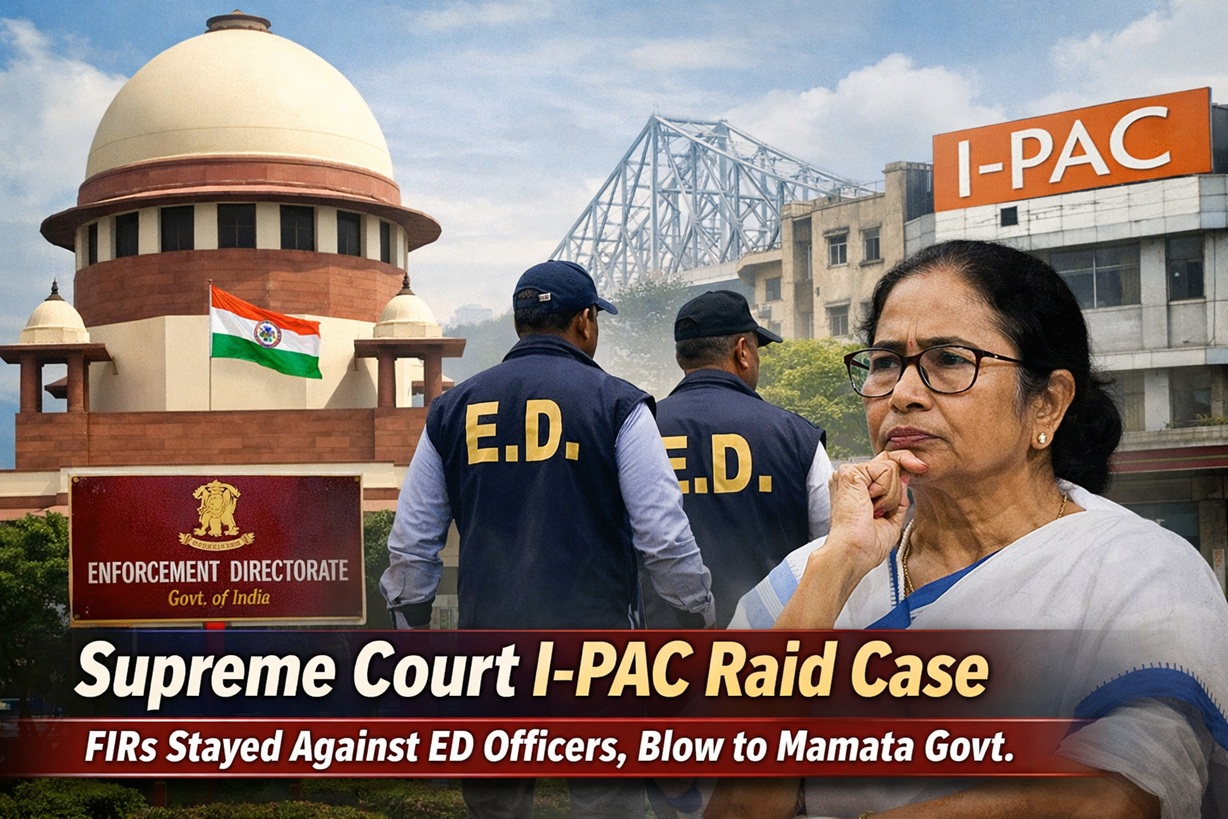
Supreme Court I-PAC raid case sees FIRs against ED officers stayed; notices issued to Mamata Banerjee government
The Supreme Court I-PAC raid case takes a decisive turn as the apex court on Thursday stayed FIRs lodged against Enforcement Directorate (ED) officers following searches at the political consultancy I-PAC in Kolkata, dealing a significant blow to the Mamata Banerjee-led West Bengal government. The court also issued notices to the state government, senior bureaucrats and top police officials, warning against interference in central agency investigations.
Supreme Court I-PAC raid case: What the court ordered

Hearing petitions filed by the ED, a Bench of Justice Prashant Kumar Mishra and Justice Vipul Pancholi stayed multiple FIRs registered by the Kolkata Police against central agency officials.
The Bench directed the West Bengal government, the Director General of Police, the Kolkata Police Commissioner and other senior officials to file their replies within two weeks, underscoring that “serious issues” arise when state authorities allegedly obstruct central investigations.
The next hearing in the Supreme Court I-PAC raid case is scheduled for February 3.
Court flags ‘prima facie’ interference by state authorities
In a strongly worded observation, the Supreme Court said no state government can impede the lawful functioning of central agencies. The Bench noted that the petitions raise prima facie concerns about administrative overreach and the creation of a law-and-order situation during the ED’s search operations.
Legal observers say the remarks indicate the court’s concern over a growing pattern of confrontation between state police forces and central agencies.
CCTV footage preservation ordered

To ensure the integrity of evidence, the Supreme Court directed that all CCTV footage related to the I-PAC raid incident be preserved. The court warned that any tampering or loss of evidence would be viewed seriously and fixed responsibility squarely on the state administration.
This directive is seen as a critical safeguard in the Supreme Court I-PAC raid case, particularly amid allegations and counter-allegations over seizure of documents and electronic devices.
FIRs against ED officials stayed
The Bench stayed the FIRs lodged against ED officers, effectively granting them protection until the matter is heard again. The FIRs had alleged misconduct and illegal seizure of materials during the searches.
By pausing these proceedings, the court sent a clear message that criminal action cannot be used to intimidate investigators, legal experts said.
Background: What triggered the I-PAC raid controversy
The controversy stems from ED searches at premises linked to Indian Political Action Committee (I-PAC), a political consultancy firm associated with election strategy and data analytics.
Following the searches, senior West Bengal police officials reached the spot, leading to dramatic scenes and the registration of FIRs against ED personnel. The incident escalated into a constitutional face-off between the Centre and the state.
Mamata Banerjee’s presence under scrutiny
During the hearing, arguments were advanced over the role and presence of Mamata Banerjee at the protest site. Senior advocate Kapil Sibal, appearing for the state, contended that Banerjee was present briefly and in her capacity as a party leader.
However, the court rejected this distinction, observing that the notice was issued to her as the Chief Minister of West Bengal, not merely as a political functionary.
Larger constitutional questions raised

The Supreme Court noted that if such issues are left unresolved, they could lead to lawlessness across states governed by different political parties. The Bench stressed that the independence of investigative agencies is essential for upholding the rule of law.
“These are larger questions that go to the root of federal governance and accountability,” the court observed, according to sources present during the hearing.
Why this matters beyond West Bengal
The Supreme Court I-PAC raid case is being closely watched nationally as it may set a precedent on:
• Limits of state police action against central agencies
• Protection of investigators during politically sensitive probes
• Accountability of senior political and administrative leadership
Constitutional experts say the ruling could have implications for similar confrontations in other states.
Political reactions muted, legal focus sharp
While political reactions from the Trinamool Congress and the Opposition remained guarded on Thursday, the legal fraternity described the order as a “clear assertion” of judicial authority.
“The court has drawn a red line on interference. The emphasis is now squarely on due process,” a senior Supreme Court lawyer said.
What happens next in the Supreme Court I-PAC raid case
By the next hearing on February 3, the West Bengal government and police leadership must explain:
• Why FIRs were lodged against ED officers
• The circumstances under which state officials intervened
• Compliance with the court’s CCTV preservation order
Failure to provide satisfactory answers could widen the scope of judicial scrutiny.
Whats Next?
The Supreme Court’s intervention in the Supreme Court I-PAC raid case marks a crucial moment in the ongoing tussle between state authority and central investigative agencies. By staying FIRs, demanding accountability and stressing the rule of law, the apex court has signalled that administrative power cannot override constitutional limits. With the next hearing looming, the case could reshape how federal agencies operate amid political resistance.
❓ FAQs | Supreme Court I-PAC raid case
Q: What is the Supreme Court I-PAC raid case about?
A: It concerns ED searches at I-PAC premises and alleged interference by West Bengal authorities.
Q: What relief did the ED get from the Supreme Court?
A: The court stayed FIRs lodged against ED officers and ordered evidence preservation.
Q: Why is Mamata Banerjee’s role significant in this case?
A: The court issued notice to her as Chief Minister, rejecting claims she acted only as a party leader.
Q: What did the Supreme Court say about state interference?
A: It said no state can obstruct central agencies and flagged serious constitutional concerns.
Q: When is the next hearing scheduled?
A: The matter will be heard again on February 3.
References
- https://www.ndtv.com/india-news/supreme-court-jolt-to-mamata-banerjee-in-probe-agency-ed-raid-case-fir-stayed-10754882
- https://www.indiatoday.in/india/law-news/story/raises-serious-issue-of-probe-by-central-agencies-and-states-interference-sc-issu
- https://www.livelaw.in/top-stories/supreme-court-ed-raid-on-ipac-plea-for-cbi-probe-west-bengal-cm-mamata-banerjee-state-police-
- https://indianexpress.com/article/legal-news/sc-notice-mamata-fir-ed-ipac-raids-10475110/
- https://www.hindustantimes.com/india-news/cm-mamata-banerjee-shocking-pattern-barging-in-ed-supreme-court-ipac-raid-drama-hearin
- https://timesofindia.indiatimes.com/india/sc-stays-firs-by-west-bengal-police-against-ed-over-i-pac-raids-issues-notice-to-mamat