 Digital Team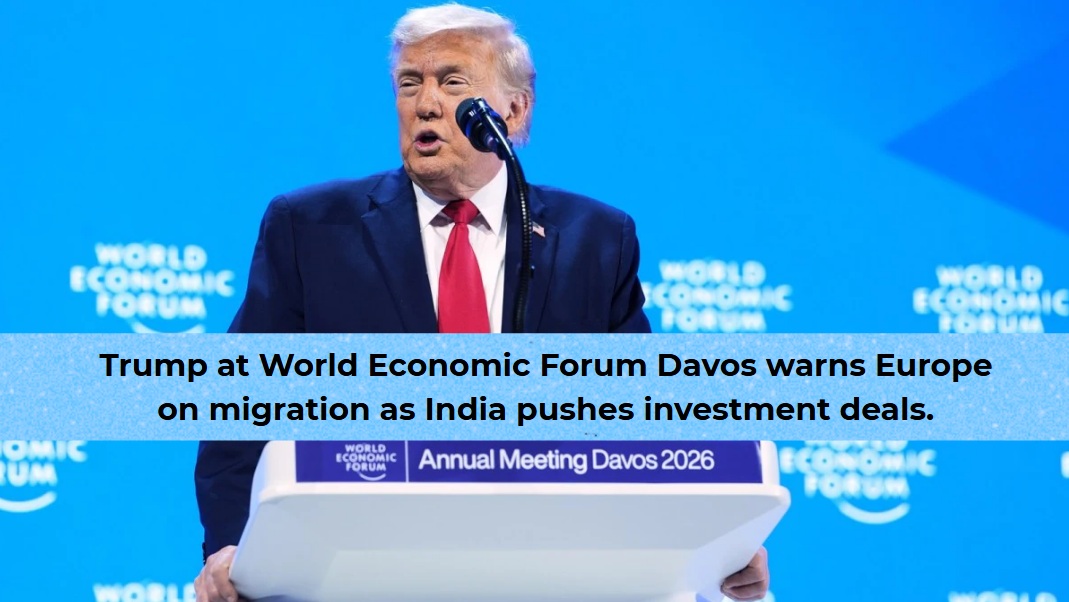
Addressing global leaders in Davos, former US President Donald Trump criticises Europe’s direction, flags mass migration risks, and dominates a forum where India pushes record investment diplomacy.
At the World Economic Forum in Davos, Donald Trump delivers a combative address warning Europe against mass migration and urging the European Union to “learn” from his administration, as geopolitical tensions—from Greenland to NATO—loom large. The five-day summit in Switzerland unfolds without China’s President Xi Jinping and India’s Prime Minister Narendra Modi, even as India fields its strongest-ever delegation to court global investment.
Trump at World Economic Forum Davos: Key Takeaways
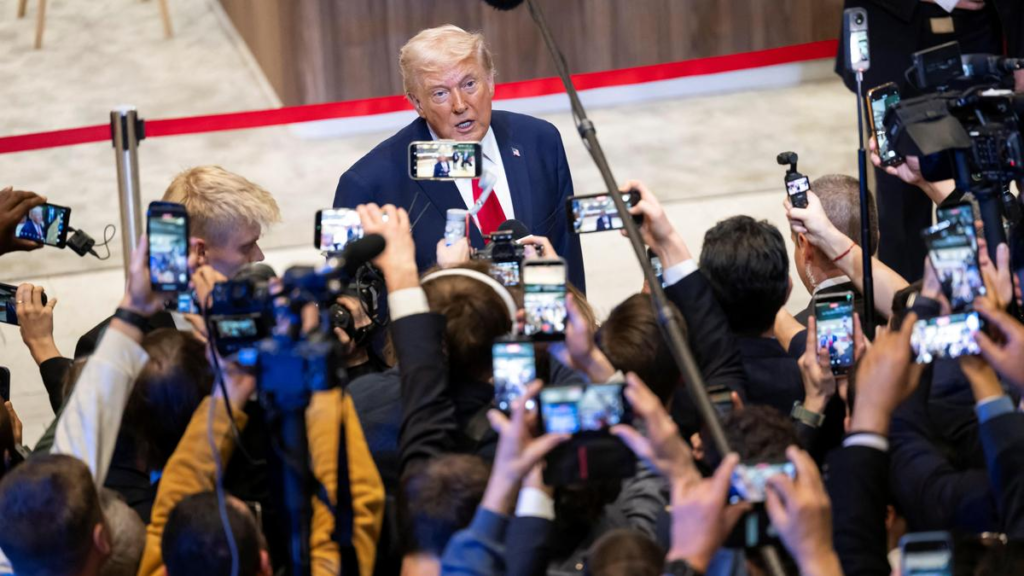
Trump’s remarks at Davos are direct and confrontational. “I love Europe, but it’s not moving in the right direction,” he says, arguing that uncontrolled migration could destabilise the continent and insisting that countries can “avoid ruin by following us.”
He calls on the European Union to reassess its policies, framing the debate as one of sovereignty, borders and economic resilience. The comments land amid heightened anxiety in Europe over security, trade and the future of transatlantic ties.
Davos Summit 2026: A Changed Global Line-up
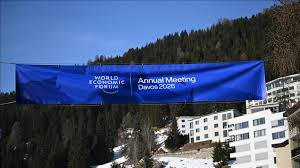
The annual gathering in Davos opens with notable absences. Neither Xi Jinping nor Narendra Modi attends this year’s meeting. India, however, compensates with scale.
A high-powered Indian delegation—including Union ministers, the National Security Advisor, chief ministers and senior bureaucrats—marks New Delhi’s most expansive presence at Davos to date. The strategy signals a shift from centre-led outreach to aggressive state-level investment promotion.
India’s Investment Push Takes Centre Stage
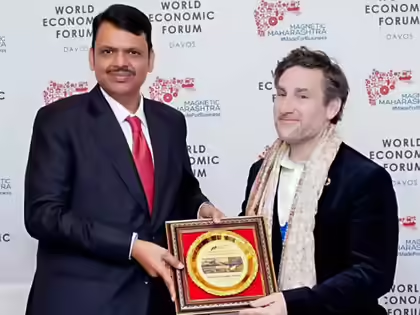
Indian states use Davos as a deal-making platform. Maharashtra Chief Minister Devendra Fadnavis signs memoranda of understanding worth nearly $70 billion, spanning infrastructure, digital platforms and manufacturing.
The approach underlines a broader recalibration: states pitching directly to global capital, positioning India as a long-term manufacturing and supply-chain hub.
EU–India Trade Talks Gain Momentum
European Commission President Ursula von der Leyen announces progress towards a sweeping India–EU free trade agreement, described by officials as the “mother of all deals”.
Negotiations with 27 EU members aim to reduce tariffs and ease market access. For India, the deal promises manufacturing gains and export parity in Europe, especially in sectors such as textiles and engineering goods.
Greenland, NATO and Trump’s Hard Power Rhetoric
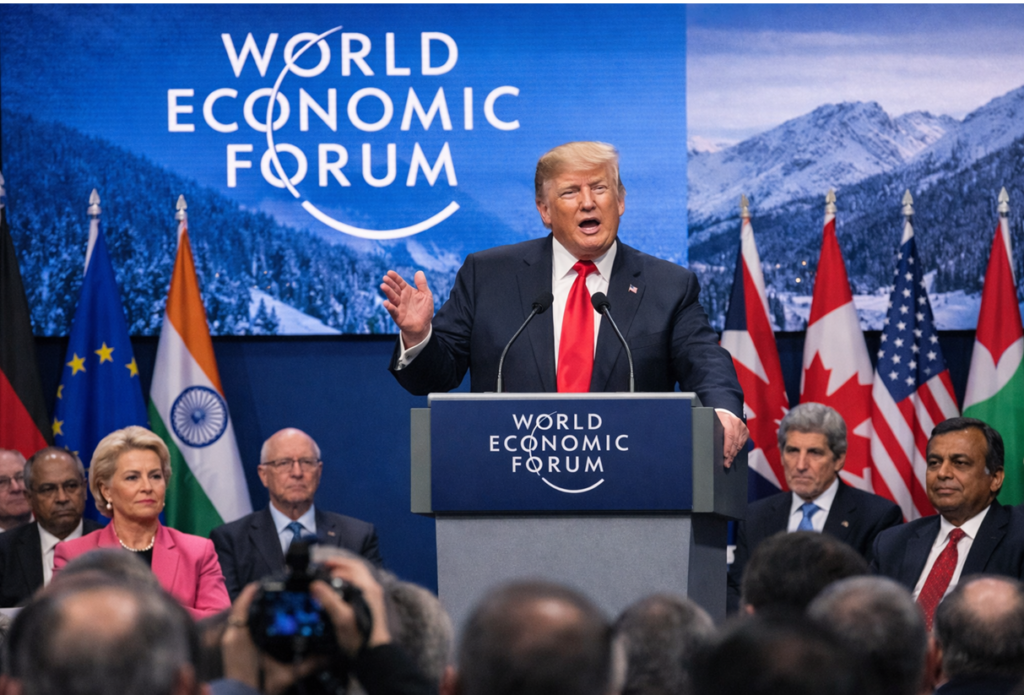
Trump’s Davos appearance comes amid controversy over his repeated claims on Greenland, an autonomous territory of Denmark, and sharp remarks about NATO’s relevance without US leadership.
European leaders respond firmly. France’s President Emmanuel Macron reiterates that “sovereignty is not for sale,” while Denmark underscores Greenland’s status as integral to its territory.
A Fractured Geopolitical Backdrop
Russia’s President Vladimir Putin adds fuel to the debate, accusing European powers of acting as American “subordinates,” even as concerns grow over China’s expanding strategic footprint across regions from West Asia to Latin America.
Against this backdrop, Trump positions himself as a disruptor—arguing that American assertiveness is a response to rising Chinese and Russian influence.
What Davos Is Watching Closely
Diplomats and investors are tracking whether Trump tempers his rhetoric or doubles down. With Europe pushing back on territorial claims and India quietly advancing trade and investment goals, Davos becomes a stage for competing visions of global order.
Whats next
Trump at World Economic Forum Davos underscores a widening divide between America-first politics and Europe’s insistence on multilateralism and sovereignty. As India leverages Davos to deepen economic ties and Europe weighs strategic autonomy, Trump’s intervention sharpens the debate over who sets the rules of the global economy—and at what cost.
FAQs
Q: What did Trump say at the World Economic Forum Davos?
A: Trump criticised Europe’s migration policies and urged the EU to learn from his administration’s approach.
Q: Why is Trump’s Davos speech controversial?
A: His remarks on migration, Greenland and NATO challenge European sovereignty and transatlantic norms.
Q: Who is missing from Davos 2026?
A: China’s Xi Jinping and India’s Narendra Modi are absent, though India has sent a large delegation.
Q: What is India’s focus at Davos this year?
A: Attracting investment through state-led pitches and advancing trade partnerships, including with the EU.
Q: What is the status of the India–EU FTA?
A: Talks are advancing, with leaders calling it a potential landmark trade agreement.
References
- Fox News: Detailed coverage of Trump’s speech ripping Europe on migration and spending. https://www.foxnews.com/politics/trump-rips-europe-davos-wrong-direction-points-migration-spending
- Moneycontrol: Trump warns West is destroying itself, targeting immigration and Europe’s policies. https://www.moneycontrol.com/world/davos-2026-trump-warns-west-is-destroying-itself-targets-immigration-and-ilhan-omar-article-1
- The Atlantic: Analysis of Trump’s Davos speech alienating allies on Europe and immigration. https://www.theatlantic.com/newsletters/2026/01/trump-davos-speech-world-economic-forum/685692/
- Al Jazeera live updates on Trump’s Davos remarks amid Greenland threats. https://www.aljazeera.com/news/liveblog/2026/1/21/trump-live-news-us-president-in-davos-as-greenland-threats-spark-outrage