 Digital Team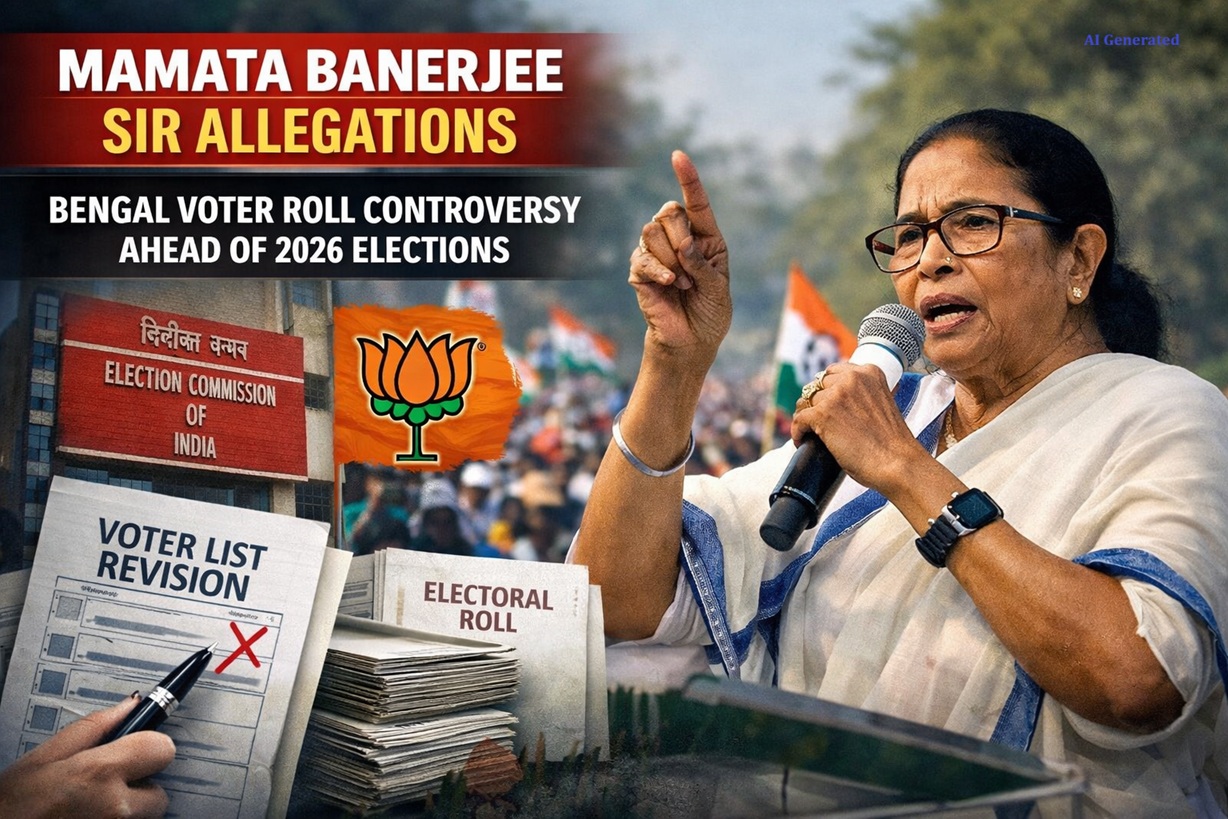
Mamata Banerjee SIR allegations have triggered a major political controversy in West Bengal as the state heads toward the 2026 Assembly elections.
Mamata Banerjee SIR Allegations and the Voter Roll Controversy
West Bengal Chief Minister Mamata Banerjee on Tuesday escalates her confrontation with the Election Commission (EC), alleging that BJP-leaning officials are being deployed for the Special Intensive Revision (SIR) of electoral rolls in the state ahead of the 2026 Assembly elections. Addressing public meetings and party forums, Banerjee claims the SIR is being “weaponised” to influence voter lists, a charge the Bharatiya Janata Party (BJP) rejects, asserting the exercise follows due process nationwide.
Why Mamata Banerjee Raises SIR Allegations Now
Mamata Banerjee SIR allegations dominate Bengal’s political discourse
Political observers say the Mamata Banerjee SIR allegations have sharpened the TMC vs BJP battle over electoral integrity in Bengal. With less than a year to the polls, the Mamata Banerjee SIR allegations inject a fresh edge into Bengal’s polarised politics. The Trinamool Congress (TMC) argues that deputing “politically inclined” officials for SIR risks disenfranchising genuine voters, particularly migrants and the urban poor. Banerjee warns that any attempt to obstruct the process could be misread as a pretext for constitutional overreach.
TMC leaders say the timing of SIR—so close to elections—has heightened anxieties. “Electoral integrity cannot be selective,” a senior party functionary says, urging transparency and state-level consultations.
What Is SIR and Why It Matters
Special Intensive Revision in West Bengal
The Special Intensive Revision West Bengal is a periodic EC exercise to update electoral rolls by verifying addresses, removing duplicates, and deleting entries of deceased or migrated voters. Officials say SIR strengthens democracy by ensuring clean voter lists.
However, TMC leaders contend that scale and pace matter. Unofficial estimates circulating in political circles suggest a large number of deletions could occur, triggering fears of wrongful exclusions if safeguards are not robust.
BJP’s Counter: ‘Routine Process, No Political Colour’
The BJP dismisses the Bengal SIR political row as a diversion. Party leaders argue that similar revisions have taken place in other states, including Bihar, without controversy. “SIR is standard EC procedure. Allegations of bias are unfounded,” a BJP spokesperson says, accusing TMC of pre-emptively questioning institutions.
Election Commission’s Position
While the EC has not issued a detailed rebuttal to the latest charges, officials reiterate that all revisions follow statutory rules, with multiple checks, public notice periods, and grievance redressal mechanisms. Sources indicate that Booth Level Officers (BLOs) and supervisors are drawn from existing administrative pools under established norms.
Voter Deletions: Fear vs Facts
Voter deletion fear in Bengal
A key plank of the controversy is the voter deletion fear in Bengal. TMC leaders claim that migrants who once registered in Bengal but now live elsewhere could see names removed, impacting constituencies with high mobility.
Election experts counter that deletions require verification and appeals. “No name is struck off without due notice,” a former EC official notes, adding that voters can file claims and objections within prescribed timelines.
Anti-Incumbency, Corruption Cases and the Political Undercurrent
Beyond SIR, the debate intersects with broader political currents. Corruption cases involving senior TMC figures—now before courts—feature prominently in BJP’s campaign narrative. The party says documented investigations and judicial proceedings, not rhetoric, will shape voter opinion.
TMC responds that governance outcomes and welfare schemes will outweigh allegations. Still, analysts say the optics of ongoing probes add pressure in a tightly contested election cycle.
Shifting Social Coalitions and Voter Sentiment
Observers note churn within Bengal’s social coalitions. Urban middle classes and sections of the intelligentsia appear more vocal on governance and safety issues, while rural blocs remain influenced by local dynamics and welfare delivery. Minority voters, long considered a TMC stronghold, are also weighing expectations against outcomes, political analysts say.
What the Law Says
Alleged manipulation of electoral rolls—what safeguards exist
Under the Representation of the People Act and EC guidelines, electoral roll revisions mandate:
- Public display of draft rolls
- Notice to affected voters
- Time-bound objections and appeals
- Final publication only after scrutiny
Legal experts underline that courts have consistently upheld EC autonomy, while also insisting on procedural fairness.
What Happens Next
As the SIR exercise ahead of 2026 Bengal polls continues, the immediate test will be transparency—clear communication from the EC, accessible grievance channels, and verifiable data. Politically, the issue is set to remain a flashpoint, sharpening campaign narratives on institutional trust and voter rights.
The Mamata Banerjee SIR allegations underscore a high-stakes battle over electoral integrity as Bengal moves toward 2026. With parties entrenched and institutions under scrutiny, the coming months will hinge on process credibility and public confidence—factors likely to shape both turnout and outcomes.
FAQs
Q: What are Mamata Banerjee’s allegations on SIR?
A: She alleges BJP-leaning officials are being deployed, risking biased voter list revisions.
Q: What is Special Intensive Revision (SIR)?
A: A statutory EC process to update electoral rolls by verifying entries and removing duplicates.
Q: Can voters challenge deletions during SIR?
A: Yes. Voters can file claims and objections within notified timelines.
Q: Has the EC responded to the bias charge?
A: The EC reiterates adherence to rules and safeguards; a detailed response is awaited.
Q: Why is SIR contentious before elections?
A: Timing raises fears of wrongful exclusions impacting electoral outcomes.
Also Read: https://dailydozes.com/tmc-sir-voter-deletions-kolkata/
TMC SIR voter deletions: 11 Lakh Voters Put Kolkata Seats at Risk
References: