 Digital Team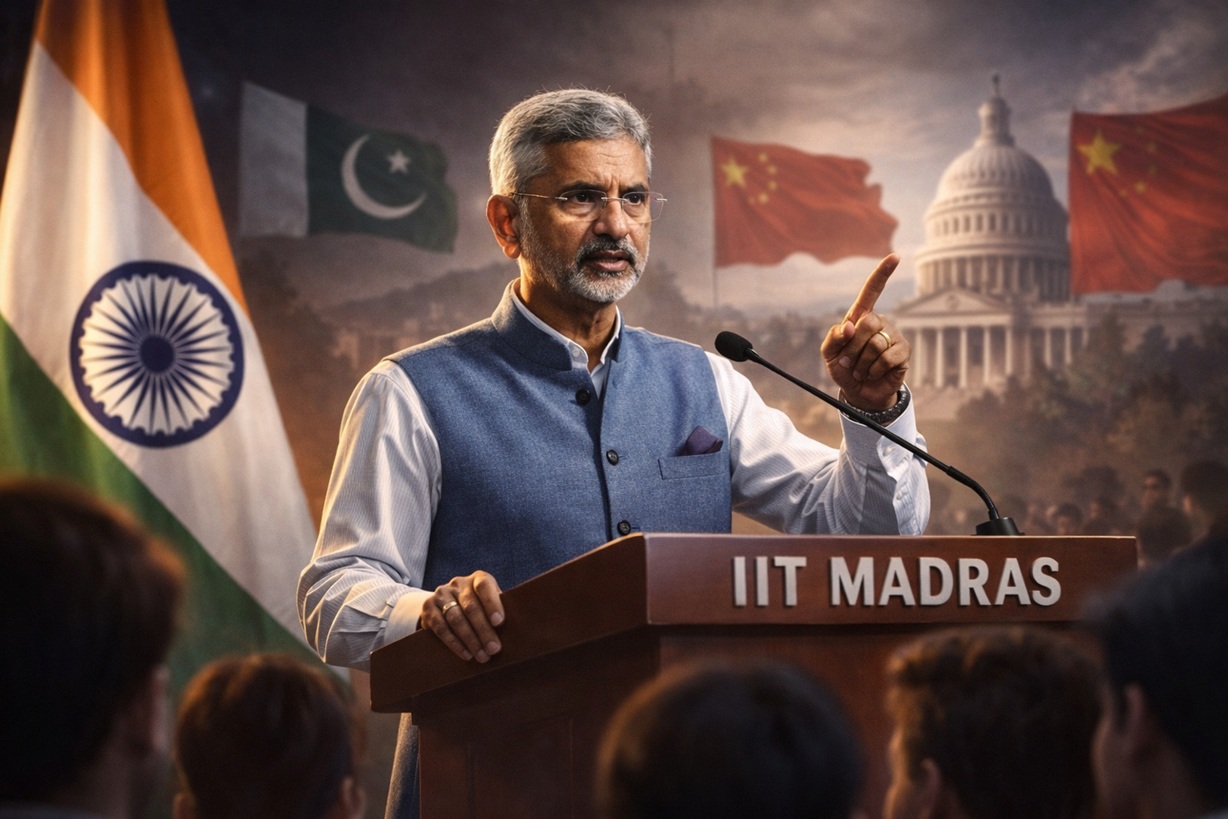
At IIT Madras, External Affairs Minister S Jaishankar delivers a pointed message on terrorism as well as sovereignty and India’s neighbourhood policy, with clear signals for Pakistan and beyond.
On Thursday, India’s External Affairs Minister S Jaishankar condemned Pakistan as a “bad neighbour,” stating that terrorism as a state policy would not be acceptable to India. Speaking at IIT Madras, Chennai, Jaishankar said New Delhi retains the sovereign right to defend its citizens which it cannot be governed by external pressure, foreign advice or threats.
India’s Position on Pakistan and Terrorism
Addressing students during an interactive session, Jaishankar reiterated that India’s foreign policy is guided by clarity, not ambiguity. “If a country deliberately and persistently uses terrorism as an instrument of state policy, it cannot expect normal relations,” he said, refraining from directly naming Pakistan in every instance.
India’s national security decisions go through New Delhi and not foreign capitals, according to the foreign minister. “Our right to protect our people will not be determined by others,” he added.
‘Water and Terrorism Cannot Go Together’: Indus Treaty Signal
Among the most widely watched comments connected to the Indus Waters Treaty, a historic pact between India and Pakistan. Jaishankar reiterated a principle: “Water and terrorism cannot go together.”
Not officially stating a change, he said agreements based on goodwill are still valid only in a situation where goodwill exists — a statement that has been widely read as a warning that cross-border terrorism is damaging a bilateral context.

Clear Message Beyond Pakistan
While Pakistan continued to provide the immediate reference point, Jaishankar placed his remarks into a wider neighbourhood and global context. External interference in India’s internal security matters, he emphasized, will not be accepted, and he said that this comment was viewed as relevant not only towards Pakistan, but major powers and regional actors in turn.
India, he said, has a rule of “speaking plainly so that there is no confusion about intent,” which rejects diplomatic doublespeak.
India’s Neighbourhood Policy: Good Neighbours vs Bad Neighbours
Jaishankar differentiated between friendly neighbours and belligerent neighbours, suggesting cooperation is a function of their behaviour.
- Peaceful coexistence facilitates conversation and agreements
- Persistent hostility undermines trust
- When terrorism is supported, normal relations are impossible
“Goodwill cannot be one-sided,” he said, underlining that India would respond strongly if it is provoked.
Book to read: https://www.amazon.in/India-her-neighbours-Hardcover-Andrew/dp/9362088940
Regional Security and Diplomatic Activities
The foreign minister’s remarks are part of intense regional security concerns, notably intelligence alerts, cross-border threats and diplomatic interactions throughout South Asia. India has repeatedly expressed its calls to neighbouring countries to stop their territories being used for anti-India activities and warned that failure to do so would have consequences for bilateral relations.
Jaishankar and India’s Foreign Policy
During the Jaishankar regime, the diplomacy of India has centered more on:
- Strategic autonomy
- Zero tolerance for terrorism
- Clear red lines on sovereignty
- Less reliance on outside mediation
The minister also affirmed that India neither seeks any conflict nor shies away from defending itself.
Strategic Clarity, Not Rhetoric
Jaishankar’s IIT Madras address was not merely a rhetorical warning; it was a strategic statement of purpose – a statement of intent. By linking terrorism, diplomacy and sovereignty, India’s statement signalled that future engagement with neighbours will be based on how they act.
As India grows in stature globally, New Delhi is clearly determined to respond to security threats on its own terms, pointing the way to a conclusion that terrorism entails both diplomatic and strategic costs.
FAQs
Q: What did S Jaishankar say about Pakistan?
A: He described Pakistan as a “bad neighbour” for using terrorism as a political tool.
Q: Did Jaishankar announce changes to the Indus Waters Treaty?
A: No, but he warned that goodwill-based agreements cannot coexist with terrorism.
Q: Where did Jaishankar make these remarks?
A: During an interaction with students at IIT Madras in Chennai.
Q: Was the message directed only at Pakistan?
A: While Pakistan was central, the remarks carried broader regional and global signals.
Q: What is India’s core message on terrorism?
A: India will defend its citizens without external pressure or interference.
References