 Digital Team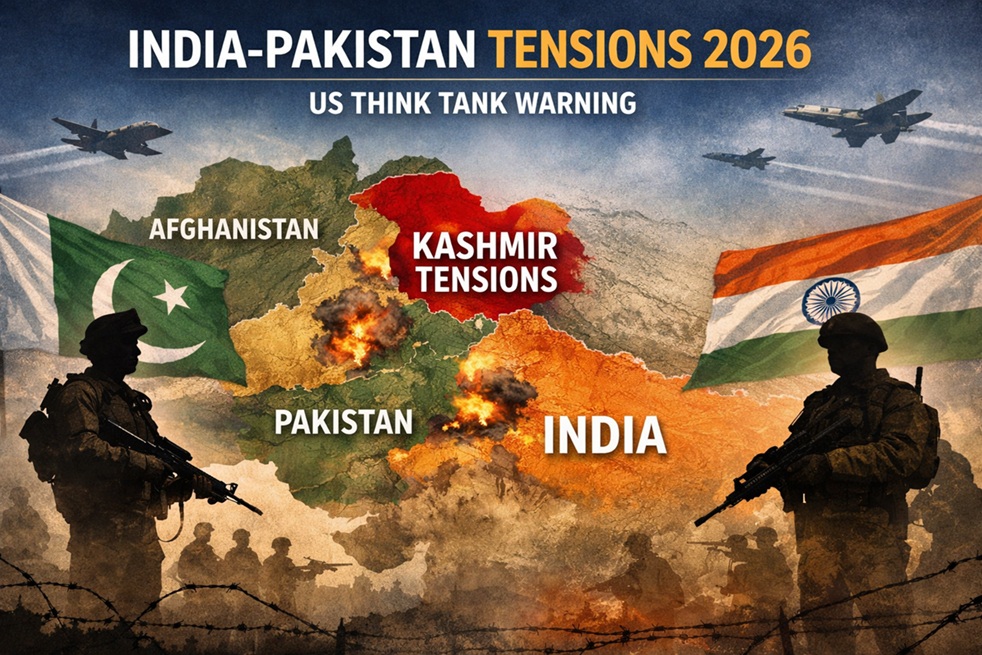
Council on Foreign Relations flags Kashmir terrorism, Pakistan instability as key triggers
A top US think tank, the Council on Foreign Relations, says there’s a real risk that India and Pakistan could end up in an armed conflict in 2026. The group points to a surge in terrorist attacks in Jammu and Kashmir, along with growing chaos inside Pakistan, as the main drivers. Their latest “Conflict to Watch 2026” report singles out South Asia as a major trouble spot—one that might not shake the whole world, but would seriously rattle the region. This warning lands at a time when India’s military is on high alert, cross-border terror threats haven’t let up, and Pakistan faces deepening economic troubles and security problems at home.


Source: https://www.cfr.org/report/conflicts-watch-2026
India-Pakistan Tensions 2026: What the CFR Report Says
The warning is the latest in the Center for Preventive Action (CPA) annual report, tracking potential global conflicts that might shape U.S. interests. According to the report:

- A fresh India-Pakistan military confrontation in 2026 is a credible risk.
- The trigger is likely a large-scale terror attack in Jammu and Kashmir.
- Pakistan’s internal fragility might encourage external escalation.
- Any India-Pakistan confrontation would affect US interests on a moderate level, but with intense regional consequences.
“Continued militant violence in Kashmir may produce an Indian military response, risking rapid escalation between two nuclear armed neighbours,” the report states.
Kashmir Terrorism Identified as Major Flashpoint
The CFR assessment notes that terrorism infrastructure in Pakistan-based networks is still operational, despite counter-terror efforts. As the report noted, security analysts said:
- More than 30 militants are thought to be active in parts of Jammu region.
- Winter conditions may postpone, not discourage, infiltration efforts.
- An attack with high casualties could lead to a rapid Indian response.
It is India’s long-held position that terrorism and talks cannot cohabitate, which was reaffirmed in instances of other crises like Uri (2016) and Pulwama (2019).
Military Posture and Defence Modernisation in India
The report acknowledges India’s briskening of defence preparedness. Recent developments include:
- Clearance of ₹79,000 crore defence acquisitions by the Defence Acquisition Council.
- Focus on drones; precision weapons; surveillance systems; and missile technology.
- Focus on rapid response capabilities and cross-border strikes.
Although the CFR does not forecast intent, it indicates that India’s deterrent posture has visibly hardened since the Balakot airstrikes.
Risk of External Escalation Deepens as Pakistan’s Internal Crisis Deepens
Most of the CFR discussion emphasises Pakistan’s domestic crisis which it considers to be a destabilising influence. Key concerns flagged:
- Escalating militant violence in Balochistan and Khyber Pakhtunkhwa.
- Balochistan Liberation Army (BLA) attacks on security forces.
- Economic distress due to austerity and privatisation imposed by the International Monetary Fund (IMF).
- Political instability and strained civil-military relations.
“Leaders experiencing crises of internal legitimacy are often forced to confront others internationally,” the report warns.
Afghanistan-Pakistan Tensions: Risk of Conflict Parallel To India-Pakistan
The CFR also notes a comparable but related threat — another kind of conflict between Afghanistan and Pakistan. Drivers include:
- Cross-border attacks by Tehreek-e-Taliban Pakistan (TTP)
- Clashes along the Durand Line.
- Strained relations between Islamabad and the Taliban leadership in Kabul.
This conflict is regarded as less likely to have international, if any, impacts, and because India-Pakistan disputes remain, the potential crises in these two regions coexist.

Why America Is Observing Closely
The Conflict to Watch report is intended to help US policymakers predict geopolitical events. The CFR assesses that:
- South Asian conflict would disrupt global markets and regional stability.
- Nuclear escalation remains unlikely but cannot be ruled out.
- Crisis miscalculation remains the biggest risk.
The report avoids political commentary but highlights the importance of preventive diplomacy and counter-terror accountability.
Strategic Context: India-Pakistan Tensions

India’s position is still rooted in:
- Total zero tolerance of cross-border terrorism.
- Firm retaliation doctrine.
- Diplomatic isolation of terror sponsors.
Pakistan, meanwhile, is under pressure from:
- Global lenders calling for reforms.
- Chronic internal security failures.
- Reduction of fiscal space for governance.
Analysts describe this asymmetry of stability as increasing the risk of misadventure.
What Happens Next
The CFR report doesn’t predict inevitability, but acts as a strategic warning. Key watchpoints going forward:
- Levels of terror activity in Jammu and Kashmir.
- The trajectory of Pakistan’s internal security.
- Channels for diplomatic engagement between New Delhi and Islamabad.
- Mechanisms for crisis communications between militaries.
The next 12–18 months, the report says, will prove crucial for whether deterrence succeeds — or doesn’t.
Whats Next
A turbulent regional equation driven by terrorism, military readiness, and domestic tensions will be underscored by the CFR’s warning on India-Pakistan tensions in 2026. Though war is not inevitable, the report warns that the margin for error is narrowing: restraint, accountability and counter-terror action matter more than ever.
FAQs
Q1: Why does the CFR warn about India-Pakistan conflict in 2026?
A renewed terror attack in Kashmir combined with Pakistan’s internal instability could trigger escalation.
Q2: Does the report predict a full-scale war?
No, it flags a high risk of conflict, not certainty.
Q3: What role does Kashmir play in India-Pakistan tensions?
Kashmir remains the most likely flashpoint for military escalation.
Q4: How does Pakistan’s economy affect security risks?
Economic stress and political instability increase the risk of external diversion.
Q5: Is the US directly involved?
The US monitors the situation due to regional and global security implications.
References:
https://www.cfr.org/report/conflicts-watch-2026