 Digital Team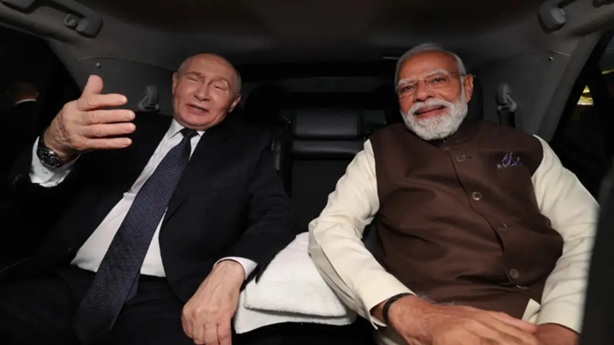
A dramatic moment unfolded in the US Congress when a Democratic lawmaker held up the viral Modi–Putin car photograph to accuse Donald Trump of damaging the India–US partnership through coercive trade policies.
The Modi-Putin Viral Car Pic Rattles US? Democrat Flashes Photograph In House To Mock Trump episode dominated a heated Congressional hearing on the India–US strategic partnership. Democratic Ranking Member Sydney Kamlager displayed the now-famous image of Prime Minister Narendra Modi riding with Russian President Vladimir Putin as evidence that former President Donald Trump’s “confrontational trade policies” had weakened US leverage and pushed India closer to alternative global partners.
Modi–Putin Photo Sparks Political Storm in US Congress
A viral car photograph featuring Prime Minister Narendra Modi seated beside Russian President Vladimir Putin became the centrepiece of a fiery debate inside the House Foreign Affairs Subcommittee. As members discussed deteriorating bilateral ties, Democratic lawmaker Sydney Kamlager held up the poster-sized image, declaring that Trump—not India—had inflicted lasting damage on the strategic partnership.
Kamlager argued that Trump’s tariff-heavy, pressure-driven diplomacy had eroded goodwill painstakingly built over decades.
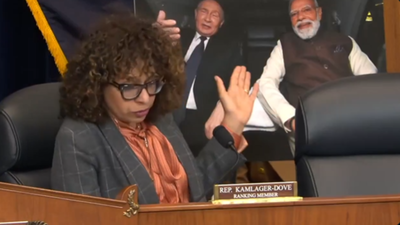
“You cannot coerce strategic partners and expect loyalty,” she said.
“This picture is worth a thousand words.”
The gesture instantly went viral, symbolising the widening rift between Washington and New Delhi under Trump’s trade regime.
Trump Accused of “Driving India Into Russia’s Arms”
According to Kamlager, Trump’s policies amounted to “cutting off our nose to spite our face”. She warned that coercive tactics had weakened strategic trust and pushed India toward deeper engagement with Russia — visually underscored by the photo she held aloft.
She added:
“You don’t get a Nobel Peace Prize by alienating your strongest partners.”
The lawmaker’s remarks stunned the committee room, marking one of the strongest indictments yet of Trump’s approach to India.
How the Modi-Putin Viral Car Pic Became Evidence in a Policy Debate
The car photograph, shot during Modi’s recent Moscow visit, has circulated widely on social media. But its entry into the official Congressional record marked a new political flashpoint:
- It was used to illustrate India’s growing diplomatic autonomy
- It signalled US frustration with failed pressure-based trade tactics
- It demonstrated how visuals now shape foreign policy narratives
As the image loomed behind her, Kamlager claimed Trump had “flushed down the toilet” the strategic capital amassed under previous administrations.
Senate Panel Echoes Criticism; US Rep Admits India Is “A Tough Nut to Crack”
While the House hearing went viral, the Senate Appropriations Committee held its own parallel session, where US Trade Representative Jamison Greer acknowledged that India remains firm on its red lines.
Greer told senators:
“India is a very tough nut to crack — perhaps the toughest.”
Yet he admitted that the Modi government’s latest market access proposals were “the best offers the US has ever received”, signalling New Delhi’s readiness to negotiate — but on fair terms.
Greer candidly noted that India refuses to compromise on:
- Meat imports
- Dairy products
- Farm-sector protections
Despite friction, he said the US now views India as a “viable alternative market” amid supply-chain diversification.
India Stands Firm as Washington Softens
The testimony across both chambers highlights a significant diplomatic shift:
India has not bowed to US pressure. The US is recalibrating instead.
New Delhi’s stance remains clear:
✔ No compromise on farmers’ interests
✔ No dilution in dairy protections
✔ No concessions that undercut domestic livelihoods
This firmness has earned India unexpected bipartisan respect — even as it fuels the narrative surrounding the Modi-Putin Viral Car Pic Rattles US? Democrat Flashes Photograph In House To Mock Trump moment.
Will Tariffs Finally Be Rolled Back?
Analysts now expect movement on easing Trump-era tariffs of nearly 50% on certain Indian goods.
A senior official hinted that once Supreme Court-related uncertainties clear and trade talks conclude, tariff reduction may be inevitable.
Current negotiations in New Delhi — involving a US delegation stationed until the 12th — indicate that both nations are working toward a broader reset.
Larger Significance of the Modi–Putin Viral Car Photo
The photograph has now transcended symbolism.
It illustrates:
- India’s strategic independence
- Washington’s waning influence under coercive tactics
- The evolving contours of multipolar diplomacy
The fact that a Congressional member used it to chastise a former US President demonstrates how dramatically the India–US discourse has shifted.
A New Chapter in India–US Diplomacy
The episode underscores a powerful truth:
India will not be strong-armed — and Washington must adapt.
As both countries prepare for a recalibrated trade framework, the memory of the moment when the Modi-Putin Viral Car Pic Rattles US? Democrat Flashes Photograph In House To Mock Trump inside Congress will remain a landmark in bilateral history.
FAQ
Q1: Why did a US Democrat flash the Modi–Putin car photo in Congress?
A1: To criticise Donald Trump’s trade policies and argue that his approach pushed India closer to Russia.
Q2: How did the Modi-Putin viral car pic impact US political debates?
A2: It became a visual symbol of deteriorating India–US relations under Trump’s confrontational trade tactics.
Q3: Is India softening its stance in trade talks with the US?
A3: India remains firm on farm and dairy protections but has offered its best market-access proposals so far.
Q4: What did the US Trade Representative say about India?
A4: He called India “a tough nut to crack” but praised New Delhi’s latest offers as the best received to date.
Q5: Are Trump-era tariffs on India likely to be removed?
A5: Lawmakers hinted that the 50% tariffs are unsustainable and may be rolled back soon.