 Digital Team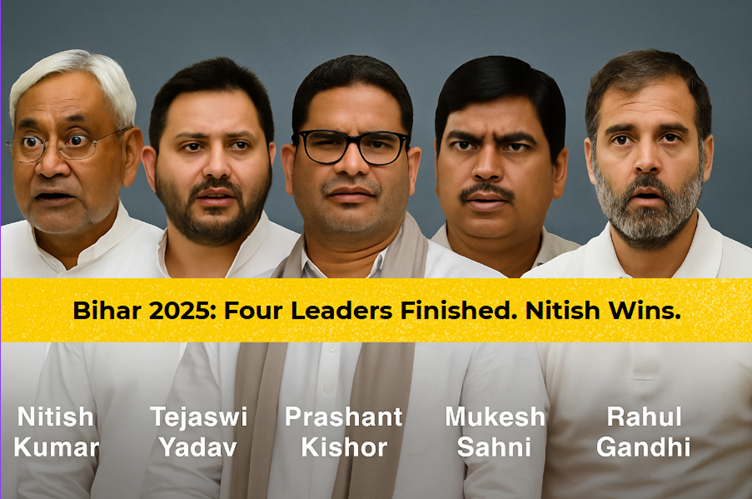
Nitish Kumar is set to resign on 19 November, only to take oath again as Chief Minister of Bihar for a record tenth time, marking yet another political reset in Patna. But while the NDA celebrates a historic mandate, the results have triggered a massive political shockwave that has rattled four major leaders — Tejashwi Yadav, Prashant Kishor, Mukesh Sahni, and Rahul Gandhi.
The Bihar verdict has not only reshaped the state’s political map but has also raised uncomfortable questions about the future relevance of these once-dominant figures.
1. Tejashwi Yadav: A Leadership Collapse in Full Public View
The RJD’s crushing defeat has drastically altered Tejashwi Yadav’s trajectory.
For the first time, even within the party, there is open whispering: “Is Tejashwi capable of rebuilding from zero?”
What Went Wrong for Tejashwi Yadav:
- The RJD remained trapped in internal feuds, family fractures, and factional fights.
- Surging influence of political “outsiders” weakened veteran Lalu-era loyalists.
- Ticket distribution controversies — from alleged favouritism to money-for-symbol whispers — destroyed credibility.
- The public began echoing a pointed question:
“If he can’t manage his own family, how can he manage a party?”
The 2025 elections were Tejashwi’s golden chance to step out of Lalu Yadav’s shadow and prove himself as an independent leader. Instead, the defeat has left him politically diminished — and the silence within RJD today speaks louder than speeches.
2. Prashant Kishor: The Grand Experiment That Crashed
Prashant Kishor, once hailed as India’s master strategist, now faces the biggest setback of his political career.
His party’s performance was not merely poor — it was electorally irrelevant.
Why PK’s Model Failed:
- Governance and strategy built around analytics, data sheets, and studio politics rather than grassroots connect.
- No organisational depth, no cadre, no boots on the ground.
- Public perception that voting for PK meant voting for Tejashwi, which alienated many.
- His politics never translated from laptops to local booths.
PK promised a revolution; Bihar delivered a reality check.
3. Mukesh Sahni: The “Son of Mallah” Who Lost His Own Boat
Mukesh Sahni dreamt of becoming Deputy Chief Minister, but the voters sent him a brutal message: opportunism has an expiry date.
Key Reasons Behind His Political Collapse:
- Constant party-hopping weakened his credibility.
- Mallah voters rejected the narrative of caste symbolism without delivery.
- Even after being declared the alliance’s Deputy CM face in some pockets, his core vote bank didn’t support him.
Political analysts now say:
“Had Sahni stayed with the BJP, he would have been a minister by now.”
But in chasing short-term glory, Sahni lost long-term relevance.
4. Rahul Gandhi: Another Election, Another Setback
Rahul Gandhi’s Bihar performance has reignited an old question:
Can he still be considered the Opposition’s national face?
Under his leadership, the Congress didn’t just lose — it dragged the entire Grand Alliance down with it.
Why Rahul Gandhi’s Strategy Failed Again:
- Over-dependence on Delhi-based advisors and studio activists.
- Repetitive anti-Modi rhetoric without any actionable political alternative.
- Narrative-building based on outrage, not organisation.
The defeat is a major blow inside the INDIA bloc itself, where murmurs of replacing him as the Opposition’s primary face are growing louder.
The Big Picture: Bihar Voted for Stability, Not Experiments
The 2025 verdict has proven one thing:
**In Indian politics, trust matters more than slogans.
Leadership matters more than promises.
Ground reality defeats glossy analytics.**
- Tejashwi Yadav lost the people’s trust.
- Prashant Kishor’s data politics collapsed at the grassroots.
- Mukesh Sahni’s opportunist model stopped selling.
- Rahul Gandhi faces an existential crisis within his own alliance.
As Nitish Kumar prepares to take oath yet again, Bihar has sent a powerful message — the state rewards consistent leadership and punishes political confusion.