 Digital Team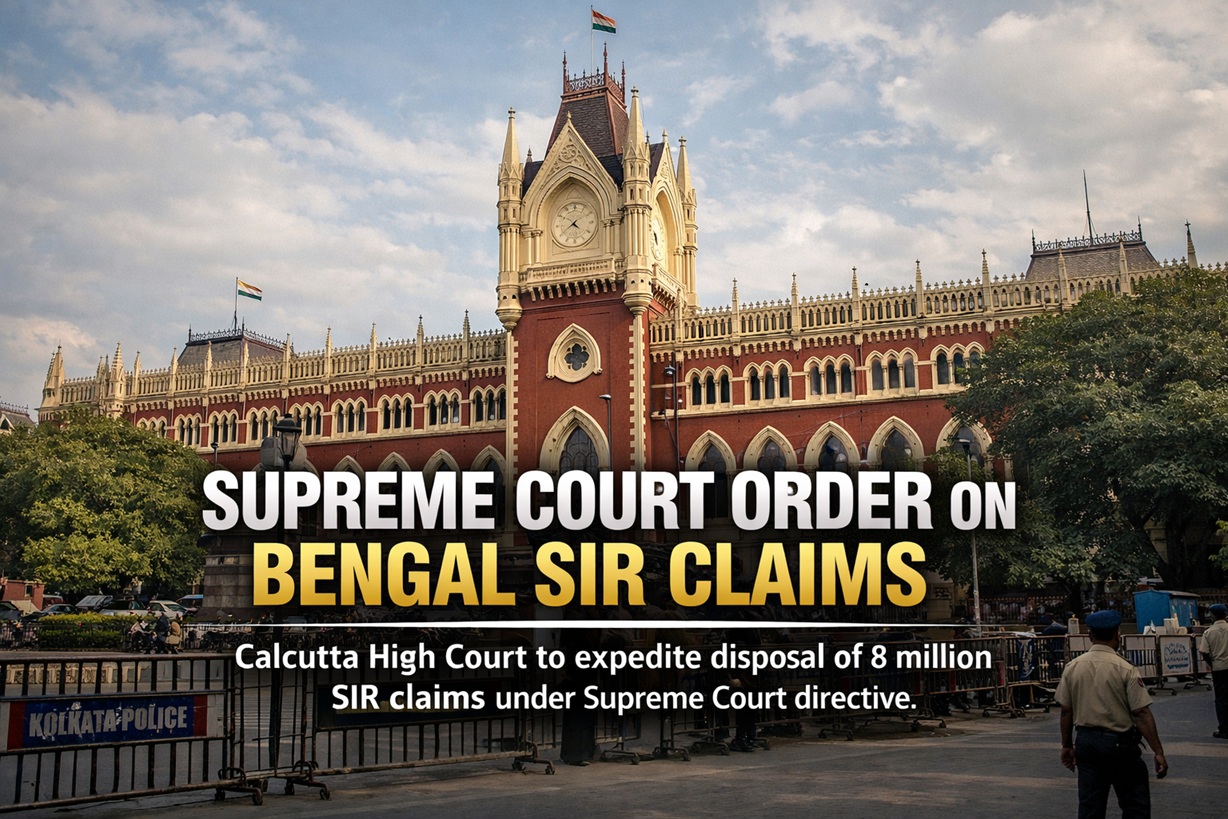
Supreme Court Order on Bengal SIR Claims: Out-of-State Judges to Fast-Track 8 Million Cases
The apex court allows judicial officers from Jharkhand and Odisha to assist Calcutta High Court; Election Commission to bear costs ahead of polls.
In a significant development ahead of West Bengal’s election cycle, the Supreme Court order on Bengal SIR claims allows the Calcutta High Court to seek assistance from civil judges in Jharkhand and Odisha to fast-track disposal of nearly 8 million claims filed during the Special Intensive Revision (SIR) of electoral rolls. The Election Commission of India will bear the expenses, the court clarified.
The decision comes amid mounting political heat, with parties gearing up for high-stakes polls and voter list scrutiny emerging as a central flashpoint.
Supreme Court Order on Bengal SIR Claims: What the Court Said
The bench of the Supreme Court of India acted after the Chief Justice of the Calcutta High Court informed it that even deploying 250 district judges would require nearly 80 days to dispose of 8 million claims.
To prevent delays in finalising the electoral roll, the apex court permitted the temporary appointment of judicial officers from neighbouring states. The Election Commission will cover administrative and logistical costs.
Legal observers say the move underscores judicial concern over timely completion of the voter list revision process before polls.
Judicial Oversight Strengthened
The court also clarified that judicial officers—not merely Assistant Electoral Registration Officers (AEROs)—would exercise substantive oversight over the scrutiny process.
Any irregularities or allegedly fake submissions filed before the February 14 deadline will undergo judicial review.
When objections were raised that judges from Jharkhand and Odisha might not understand Bengali, the Chief Justice reportedly dismissed the concern, citing historical and linguistic proximity between the states.
Political Implications of the Bengal Voter List Revision
The Bengal voter list revision now sits at the centre of electoral calculations. The final electoral roll is expected around February 28, though supplementary lists may follow closer to polling dates.
For the ruling Trinamool Congress (TMC), led by Chief Minister Mamata Banerjee, the intensified judicial scrutiny adds administrative pressure during peak campaign season.
Political analysts argue that uncertainty over voter rolls complicates booth-level planning and micro-targeting strategies.
Meanwhile, the BJP has stepped up preparations. Union Home Minister Amit Shah is scheduled to launch the party’s “Parivartan Yatra” from South 24 Parganas district on March 1.
Security Concerns Amid SIR Proceedings
Adding to tensions, six courts in West Bengal reportedly received bomb threats via email this week. Security agencies have heightened vigilance around judicial complexes.
Though investigations are ongoing, the episode has triggered debate over judicial security during politically sensitive proceedings.
Officials have not indicated any direct link between the threats and the SIR litigation.
Election Commission’s Preparations
Sources indicate that the Election Commission of India may deploy up to 2,000 companies of central forces for the upcoming polls—higher than previous assembly elections.
Key highlights:
- Central forces deployment likely to increase significantly
- Direct monitoring by central officials expected
- Judicial supervision over SIR claims scrutiny
- Supplementary voter lists possible near polling dates
If implemented, such deployment would mark one of the largest security mobilisations for state elections in recent years.
Legal Arguments Rejected
During the hearing, senior advocates Kapil Sibal and Kalyan Banerjee, representing TMC interests, argued against the need for external judicial assistance.
However, the Supreme Court rejected these submissions, emphasising the urgency of completing the SIR process without procedural bottlenecks.
The court’s intervention effectively accelerates the claims adjudication mechanism under judicial supervision.

Electoral Strategy Under Pressure
Observers say the Supreme Court order on Bengal SIR claims forces TMC to manage both courtroom proceedings and ground-level campaigning simultaneously.
While the party retains a strong grassroots network, anti-incumbency concerns and administrative preoccupation could narrow strategic flexibility.
The BJP, on the other hand, appears to be consolidating campaign momentum through yatras and public outreach programmes.
Yet, political analysts caution against reading immediate electoral outcomes from procedural developments, noting that Bengal’s political landscape remains fluid.
Timeline Snapshot
| Date | Development |
| Feb 14 | Deadline for filing SIR claims |
| Feb 28 (expected) | Final electoral roll publication |
| March 1 | BJP Parivartan Yatra launch |
| Ongoing | Judicial scrutiny of 8 million claims |
What Is Special Intensive Revision (SIR)?
The Special Intensive Revision (SIR) is a comprehensive update of electoral rolls conducted to:
- Remove duplicate or ineligible entries
- Add new eligible voters
- Correct demographic details
- Ensure compliance with electoral laws
Such revisions often intensify political contestation in closely fought states.
A Dual Battle for Bengal
The Supreme Court order on Bengal SIR claims reshapes the administrative and legal contours of West Bengal’s electoral preparation. By allowing out-of-state judges and strengthening judicial oversight, the apex court aims to expedite disposal of 8 million SIR claims before the voter list is finalised.
For Mamata Banerjee’s government, the coming weeks involve navigating legal scrutiny alongside campaign mobilisation. For opposition parties, the process presents both challenges and opportunities.
As Bengal heads toward elections, the contest appears to unfold on two fronts—inside courtrooms and across the campaign trail.
FAQ Section
Q1: What is the Supreme Court order on Bengal SIR claims?
A: The Supreme Court allowed the Calcutta High Court to appoint judges from Jharkhand and Odisha to expedite disposal of 8 million SIR claims.
Q2: Why are 8 million claims under scrutiny?
A: These claims were filed during the Special Intensive Revision of voter rolls and require verification before final publication.
Q3: When will the final voter list be published?
A: The final list is expected around February 28, with supplementary lists possible later.
Q4: Who will bear the cost of appointing external judges?
A: The Election Commission of India will bear the expenses.
Q5: How does this impact West Bengal elections?
A: It increases judicial oversight and may affect campaign planning amid voter roll revisions.
References: