 Digital Team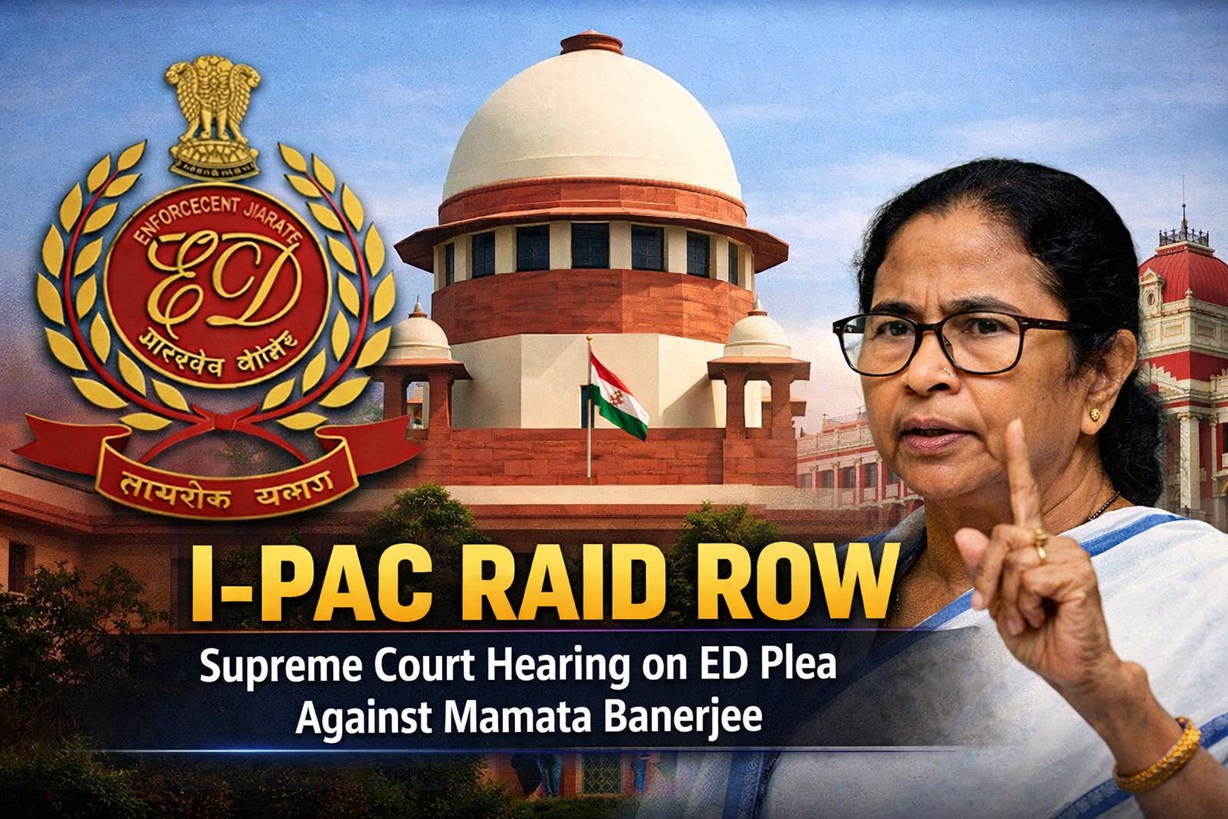
ED alleges obstruction of investigation; top court to examine claims of record removal and misuse of power
The Supreme Court of India is set to hear on Tuesday a petition filed by the Enforcement Directorate accusing Mamata Banerjee of obstructing a lawful search at the Kolkata office of Indian Political Action Committee (I-PAC), which works with the ruling Trinamool Congress. The ED has invoked Article 32 of the Constitution, alleging removal of sensitive records, interference in investigation, and abuse of official authority.
A Bench comprising Justice Prashant Kumar Mishra and Justice Vipul M. Pancholi will hear the matter.
I-PAC Raid Row: Why the Supreme Court Hearing Matters
At the heart of the dispute is whether a sitting Chief Minister can intervene in an ongoing central agency probe and take custody of material seized during a search. The ED contends that its officials were prevented from completing their operation and that files were taken away in the presence of senior state police officers.
The agency argues that such conduct undermines the rule of law and the autonomy of central investigative agencies operating under statutory mandate.
What Transpired in the Calcutta High Court
Proceedings in the Calcutta High Court on Monday were tense. Appearing for the ED, Additional Solicitor General S.V. Raju alleged that any missing records were not the agency’s responsibility. He maintained that the Chief Minister herself took custody of documents during the operation.
The High Court observed that the core issues raised by the ED are already pending before the Supreme Court and indicated that an early hearing was likely. On this basis, the ED sought adjournment of further proceedings.
However, the West Bengal government opposed the request, insisting that the High Court continue hearing the matter. After prolonged arguments, the court declined to grant relief sought by the state, effectively clearing the path for the Supreme Court hearing.
ED’s Core Allegations Explained
The ED’s petition raises serious constitutional and legal questions. Its main assertions include:
ED officials were conducting a lawful search when senior state functionaries intervened. Sensitive documents were allegedly taken away from the search premises. The presence of senior police officers, including the state’s top brass, created an atmosphere of coercion. Such actions amount to obstruction of justice and potential evidence tampering. According to the agency, the issue has moved beyond a routine raid dispute and now involves alleged misuse of executive power.
State Government’s Defence and Counterclaims

The West Bengal government has consistently argued that the raid was politically motivated and violated privacy. It has also claimed that no documents were seized by the ED and that materials taken away were sensitive political strategy papers.
Another line of defence advanced earlier was that the Chief Minister visited the premises in her capacity as a political party leader, not as the head of the executive. The ED has countered this, stating that constitutional protections under Articles 32 and 226 apply only when a person’s fundamental rights are violated—something that, it argues, was not established in this case.
Key Constitutional Questions Before the Court
The Supreme Court is expected to examine several pivotal issues:
Can a Chief Minister intervene in an active investigation by a central agency?
Does removal of documents during a search amount to obstruction of justice?
What safeguards exist to protect central agencies operating within states?
If allegations are proven, what accountability mechanisms apply to constitutional office-holders?
Legal experts say the outcome could have far-reaching implications for Centre–State relations and federal balance.
Political and Institutional Implications
The case adds to a growing list of confrontations between the West Bengal government and central institutions, including investigative agencies and constitutional bodies. While the state alleges political vendetta, the Centre maintains that agencies are acting strictly within the law.
Observers note that the Supreme Court’s ruling could define clear boundaries on executive conduct during investigations and set precedent on the limits of political authority.
What Happens Next
With the Supreme Court taking up the ED’s plea, arguments are expected to focus on constitutional propriety rather than political intent. The Bench will first decide whether the allegations merit judicial intervention and what interim directions, if any, are required.
For now, the I-PAC raid row has escalated into a high-stakes constitutional battle, with implications extending well beyond West Bengal.
As the Supreme Court hearing on the I-PAC raid row begins, the spotlight will be on whether the alleged actions constitute obstruction of investigation and abuse of power. The verdict could reshape the legal framework governing interactions between elected executives and investigative agencies, reinforcing—or redefining—the boundaries of constitutional authority in India.
FAQs |
Q1: What is the I-PAC raid row?
A: It refers to a dispute arising from an ED search at I-PAC’s Kolkata office and alleged interference by the West Bengal Chief Minister.
Q2: Why has the ED approached the Supreme Court?
A: The ED alleges obstruction of its investigation and has sought constitutional relief under Article 32.
Q3: Which judges will hear the case?
A: The Bench comprises Justice Prashant Kumar Mishra and Justice Vipul M. Pancholi.
Q4: What did the Calcutta High Court say?
A: It noted that the matter is already before the Supreme Court and did not grant relief sought by the state.
Q5: Why is the case constitutionally significant?
A: It raises questions about executive authority, federalism, and the independence of investigative agencies.
References:
- https://www.ndtv.com/video/i-pac-raid-row-ed-moves-supreme-court-alleges-interference-by-mamata-banerjee-1045465
- https://www.livelaw.in/top-stories/breaking-supreme-court-to-hear-eds-plea-against-mamata-banerjee-over-i-pac-raid-tomorrow-5190
- https://www.hindustantimes.com/india-news/ipac-raids-sc-to-hear-on-thursday-eds-plea-against-interference-by-mamata-banerjee-101
- https://www.livelaw.in/top-stories/ed-moves-supreme-court-alleging-interference-by-wb-cm-mamata-banerjee-in-i-pac-probe-518440