 Digital Team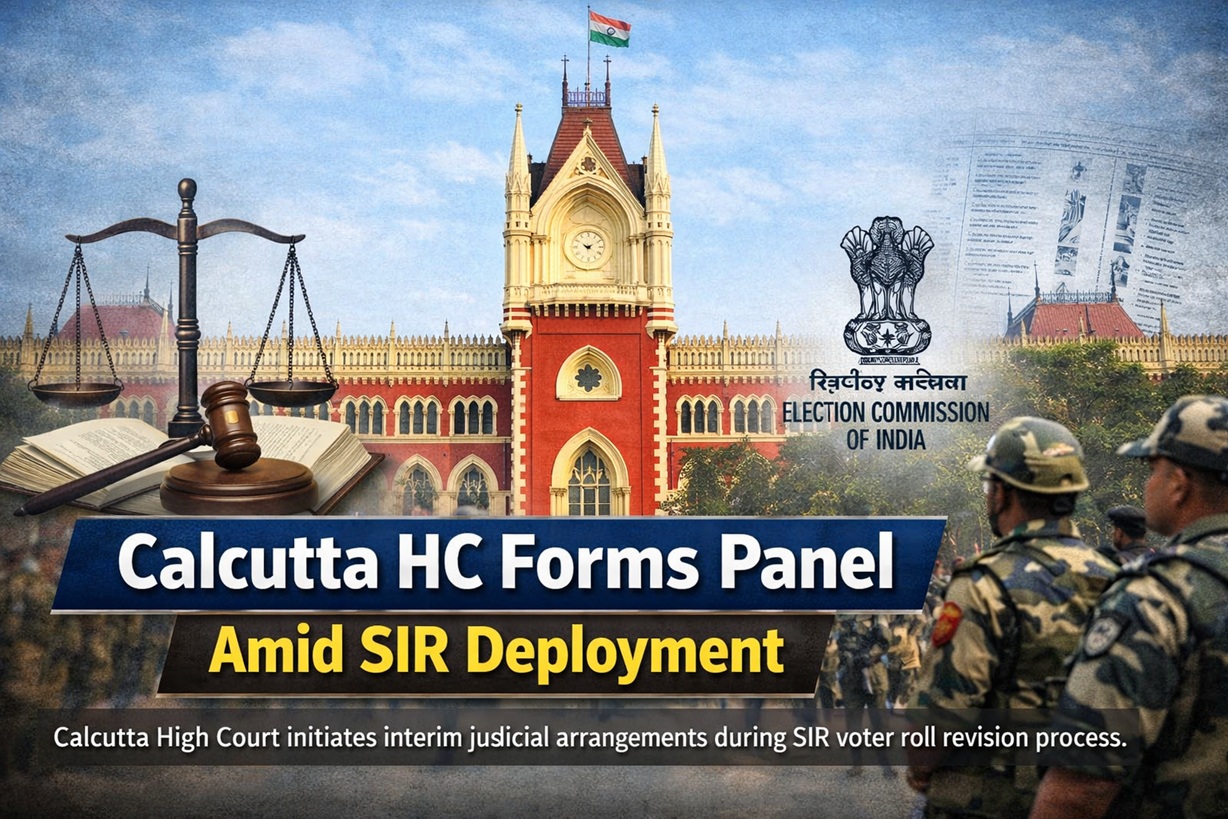
Judicial oversight intensifies as voter roll revision and political tensions reshape West Bengal’s pre-election landscape
The Calcutta HC Forms Panel decision comes amid the deployment of judicial officers for the Special Intensive Revision (SIR) of electoral rolls in West Bengal, just months before the Assembly elections. Chief Justice Sujoy Paul has constituted a committee to manage urgent court matters while judges are reassigned for SIR-related duties, signaling the scale and seriousness of the exercise.
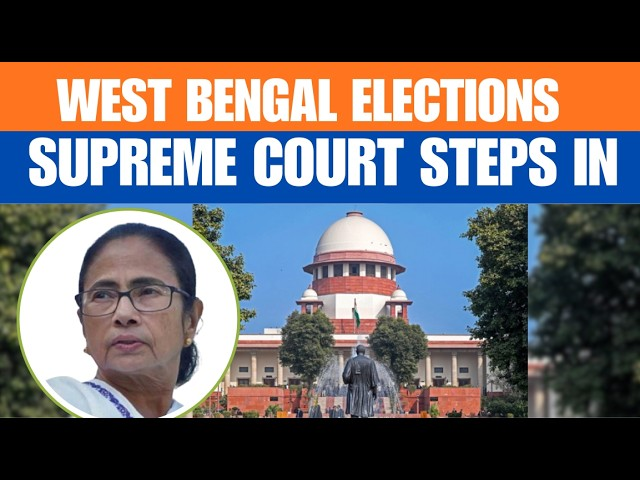
The move coincides with heightened political activity, including Prime Minister Narendra Modi’s outreach to the state and judicial monitoring backed by the Supreme Court of India.
Why Calcutta HC Forms Panel Amid SIR Deployment
The High Court administration confirmed that the committee will oversee interim arrangements for urgent case transfers to alternative courts. The decision follows the engagement of over 250 judicial officers and 150 Sessions Judges in the SIR exercise across districts.
According to court sources, the panel aims to:
- Ensure no disruption in urgent civil and criminal matters
- Reassign time-sensitive cases to functioning benches
- Monitor workload distribution across district courts
The SIR exercise is being carried out under the supervision of the Election Commission of India, with judicial oversight to ensure neutrality and transparency.
Supreme Court Monitoring and SIR Exercise Explained
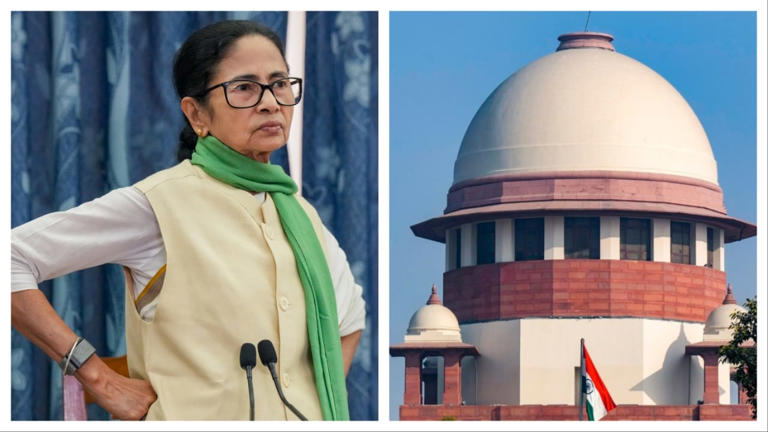
The Special Intensive Revision (SIR) is a comprehensive voter list verification process aimed at identifying duplicate, deceased, or ineligible voters.
Key Features of the SIR Deployment
| Component | Details |
| Sessions Judges Appointed | 150 |
| Judicial Officers Involved | 250+ |
| District Committees | Three-member panels |
| Verification Type | Physical verification |
| Time Frame | No strict deadline |
The Supreme Court monitoring of voter list revision has significantly elevated the stakes. Judicial involvement reduces administrative discretion and narrows political challenges to the process.
Sources indicate that lakhs of names have already been flagged for review, though official consolidated data is awaited.
Political Undercurrents as Calcutta HC Forms Panel
The judicial reshuffle unfolds amid a politically sensitive moment in Bengal.
The passing of veteran strategist Mukul Roy, who played a key organisational role in both the All India Trinamool Congress and later the Bharatiya Janata Party, has altered internal equations.
Simultaneously, Prime Minister Modi addressed a public letter to West Bengal’s citizens, referencing welfare schemes such as:
- Atal Pension Yojana
- Pradhan Mantri Ujjwala Yojana
- Ayushman Bharat
He alleged obstruction of central schemes at the state level and invoked “Jai Maa Kali,” blending governance critique with cultural messaging.
Massive Central Force Deployment in Bengal
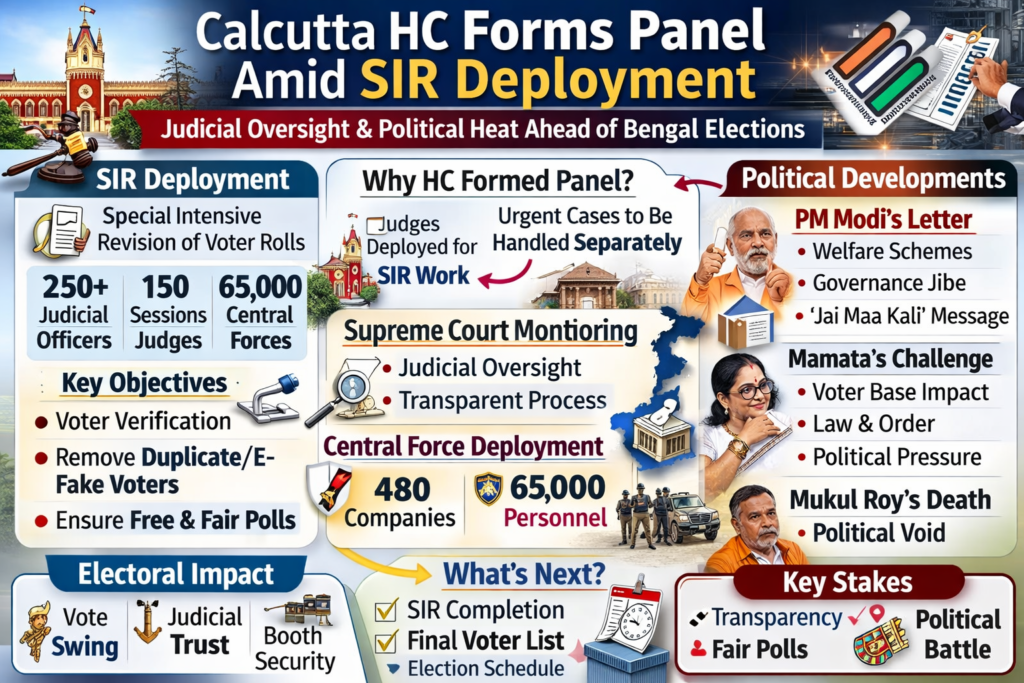
Parallel to the SIR deployment, the Ministry of Home Affairs has approved the deployment of 480 companies of central forces, including:
- Central Reserve Police Force
- Border Security Force
- Central Industrial Security Force
- Indo-Tibetan Border Police
- Sashastra Seema Bal
Nearly 65,000 personnel are expected to be stationed in border districts and communally sensitive areas.
Officials maintain that the deployment is precautionary. However, opposition leaders describe it as a “trust deficit” signal regarding state law-and-order preparedness.
Electoral Impact: What Analysts Say
Political analysts suggest the implications could be significant.
- A 3–5% vote swing can alter seat outcomes in closely contested constituencies.
- Judicial verification may reduce post-election disputes.
- Central force presence could influence voter confidence and turnout patterns.
West Bengal witnessed a tight contest in 2021, and even marginal changes in electoral arithmetic could shift the balance.
Is Mamata Banerjee Facing Multi-Layered Pressure?
While the ruling leadership has not formally responded to every development, observers identify multiple converging pressures:
- Judicial oversight of voter roll revision
- Administrative reshuffling as Calcutta HC forms panel
- Central force deployment
- Opposition narrative on governance
- Emotional resonance following Mukul Roy’s demise
Yet Bengal politics has historically defied linear projections. The coming weeks may determine whether these developments amount to heightened campaign rhetoric or signal a structural shift.
What the Calcutta HC Forms Panel Signals
The decision as Calcutta HC Forms Panel Amid SIR Deployment underscores the institutional seriousness surrounding West Bengal’s electoral preparation. With judicial officers reassigned, central forces deployed, and voter rolls under scrutiny, the administrative and political environment is entering a decisive phase.
Whether this recalibrates electoral outcomes or merely reinforces procedural transparency remains to be seen. What is certain is that the Calcutta HC forms panel at a time when governance, judiciary, and politics intersect sharply in Bengal.
FAQs
Q: Why did Calcutta High Court form a panel amid SIR deployment?
A: To manage urgent court cases while judicial officers are assigned to the voter list revision process.
Q: What is the SIR exercise in West Bengal?
A: The Special Intensive Revision is a comprehensive voter roll verification conducted under judicial supervision.
Q: Is the Supreme Court monitoring the SIR process?
A: Yes, the exercise is being carried out under Supreme Court-backed judicial oversight.
Q: How many central forces have been deployed in Bengal?
A: Around 480 companies, amounting to nearly 65,000 personnel.
Q: Could voter list revision impact election results?
A: Analysts suggest even a 3–5% shift in vote share could affect closely contested seats.
References
https://dailypioneer.com/news/calcutta-hc-forms-panel-to-manage-urgent-cases-amid-sir-deployment