Digital Team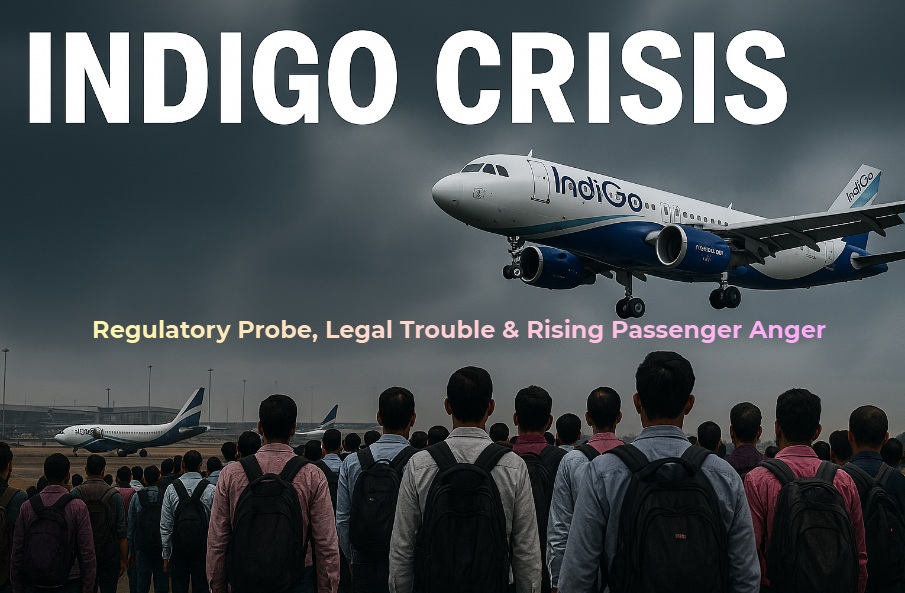
As the IndiGo crisis deepens, the airline faces DGCA action, Delhi High Court scrutiny and growing passenger outrage over mass flight cancellations, fare spikes and poor handling at airports.
A Bench of Chief Justice D.K. Upadhyaya and Justice T.R. Gedela questioned officials from the Centre and the DGCA, reminding them that over 4,600 IndiGo flights were cancelled across major airports before any meaningful intervention took place.
“Why did you allow the situation to precipitate? Are you helpless against defaulting airlines?” the court asked, signalling a stern approach to regulatory accountability.
The judges noted that the crisis went far beyond operational inconvenience. Thousands of passengers missed weddings, funerals, job interviews, medical appointments, international connections, and other irreplaceable commitments. Many complained of hostile staff behaviour, long queues, lack of information, and complete absence of crisis management.
“We will be failing in our duty if we do not point out the agony passengers faced,” the Bench said, insisting that compensation must go beyond ticket refunds to include emotional and financial suffering.
Fare Surge Raises Red Flags: ‘How Can Airlines Profit From a Crisis?’
As the IndiGo Crisis intensified, the High Court also highlighted the alarming spike in domestic airfares during the disruption. Short-distance flights that typically cost ₹5,000 were suddenly priced at ₹30,000–₹40,000, prompting accusations of predatory pricing by rival carriers.
“How can carriers take advantage of a crisis? How could fares jump from ₹5,000 to ₹35,000?” the Bench asked, calling it a case of “economic loss and systemic failure.”
The scrutiny has reignited debate about IndiGo’s near-monopoly, with nearly 60% of India’s domestic market share. Consumer rights groups and opposition leaders have urged the government to diversify competition, limit predatory pricing, and ensure transparency in airline fare algorithms.
Government Responds: Flight Cuts, Summons, Inquiry and Airport Oversight
Following public backlash and court pressure, the Centre and DGCA initiated a series of corrective and punitive measures to contain the IndiGo Crisis. The government has:
- Reduced IndiGo’s winter schedule by 10%
- Issued a show-cause notice to the CEO and COO
- Summoned the airline’s senior management for explanation
- Deployed aviation officials at major airports
- Ordered an inquiry report to be submitted to the High Court by January 22
The DGCA has stated that IndiGo failed to comply with Flight Duty Time Limit (FDTL) rules designed to prevent pilot fatigue — a critical safety issue. India currently has only 8,000 active commercial pilots for 834 aircraft, with 1,700 more aircraft on order, putting additional pressure on rostering and workforce planning.
Pilot unions have long warned that excessive flying hours and poor rostering practices can compromise safety. The IndiGo Crisis appears to validate these concerns.
Cost-Cutting Culture Under Spotlight: Profit vs Passenger Safety
Industry experts say the IndiGo Crisis has exposed the airline’s aggressive cost-cutting model, long seen as key to its profitability. Despite a record ₹7,200 crore profit in FY 2024–25, IndiGo reportedly attempted to operate its peak winter schedule without hiring 150 additional pilots — a cost of roughly ₹150 crore annually.
This, analysts say, represents barely 2% of the airline’s yearly profit.
Experts warn that years of prioritising cost efficiency may have eroded safety margins, employee morale and crisis-readiness. Common complaints include:
- Overworked pilots and crew
- Understaffed engineering teams
- Delayed service recovery protocols
- Declining customer support
- Increasing add-on fees despite shrinking service quality
This raises a fundamental industry question:
Should airline profit margins outweigh passenger safety and welfare?
Legal Oversight Begins; Passenger Rights Debate Strengthens
The High Court’s decision to oversee the inquiry signals a major shift in how India approaches aviation accountability. If compensation or regulatory steps fall short, the court may issue binding directions.
The IndiGo Crisis has reignited national conversations around:
- Passenger rights and compensation laws
- Airfare transparency and surge-control mechanisms
- Mandatory assistance protocols during disruptions
- Rules to prevent dominance by a single airline
- Stricter enforcement of pilot fatigue and safety guidelines
Consumer groups have demanded an Aviation Consumer Protection Charter, similar to European Union regulations where airlines face steep penalties for cancellations and delays.
Systemic Cracks in Indian Aviation Revealed
The IndiGo Crisis has exposed multiple vulnerabilities in India’s aviation system, including:
- Regulatory delay and poor crisis forecasting
- Shortage of trained pilots and crew
- Lack of competition leading to fare manipulation
- Weak compensation frameworks for passengers
- Airline dependence on cost-cutting instead of safety investment
With court scrutiny, DGCA action and nationwide outrage aligning, the crisis is likely to catalyse long-pending reforms across the sector.
A Turning Point for Indian Air Travel
The IndiGo Crisis has made one point unmistakably clear:
Indian passengers deserve respect, transparency, safety and fair compensation.
As regulatory pressure mounts and legal oversight deepens, India’s aviation sector may be heading toward a more accountable, transparent and passenger-first era. The crisis, though deeply disruptive, could pave the way for:
- Safer operations
- Ethical pricing
- Better staffing norms
- More competition
- Stronger consumer protection laws
If implemented well, these reforms could redefine how airlines operate — shifting the balance from profit-driven decisions to passenger-centric aviation.